Why Your Jawline Changes With Age, and What Can Be Done About It
The jawline is often the first place a face begins to look tired. Here is what is actually changing beneath the skin, and the treatments that work on each part of it.

There is a point when you may notice that your jawline no longer looks quite the way it used to.
Perhaps your lower face appears softer. Your jawline seems less defined in photographs. The area beneath your chin looks fuller. Or the sharp transition between your face and neck that you once had seems to have gradually disappeared.
It is easy to assume that this is simply “ageing skin.”
But changes to the jawline are more complicated than that.
The appearance of your jawline can be influenced by skin laxity, changes in facial fat, muscle activity, bone structure and the way different parts of the lower face interact with one another.
Understanding what is actually changing is important because the best treatment depends on the reason your jawline has changed.
What Happens to Your Jawline as You Age?
Your face does not age in one uniform way.
Different tissues change at different rates, and the combined effect can gradually alter the shape and definition of the lower face.
Over time, you may notice:
- Less definition along the jaw
- Softer transitions between the face and neck
- Increased fullness around the lower face or under the chin
- Changes in the position or distribution of facial fat
- Reduced skin firmness
- A change in the appearance of the cheeks and lower face
- More visible jowling in some people
These changes can make the jawline appear less sharp even when your actual jawbone has not changed dramatically.
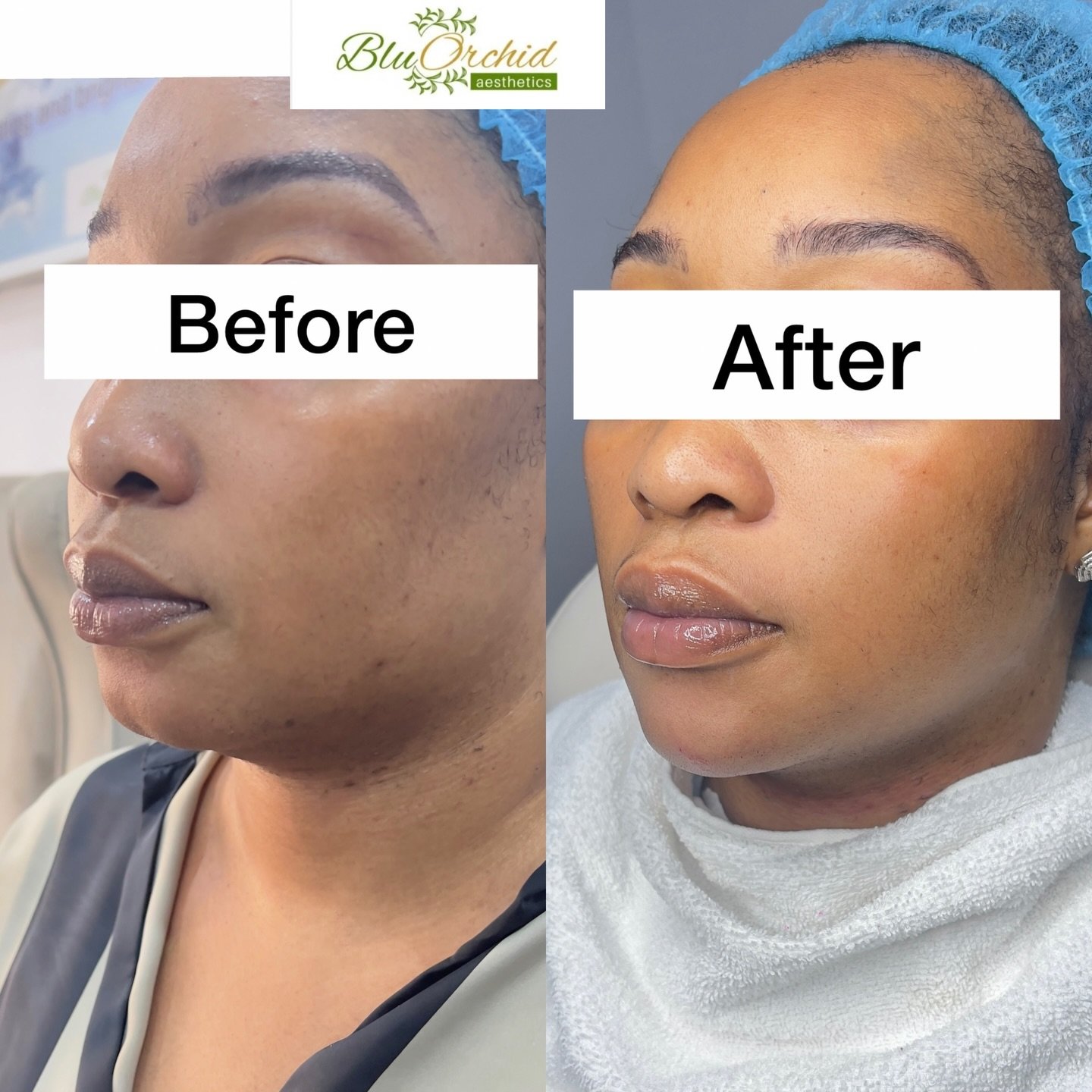
Why Does the Jawline Lose Definition?
1. The skin becomes less firm
As we age, the skin’s structure changes.
The skin gradually becomes less resilient, and the supporting structures beneath it also change. This can contribute to a softer appearance around the lower face.
For some people, this is the main reason the jawline looks less defined.
For others, it is only one part of the picture.
2. Facial fat changes
Facial fat is not simply “there” or “gone.”
Its distribution and position can change over time.
Some areas may lose volume while other areas become more prominent. This can alter the proportions of the face and make the lower face appear heavier or less sharply defined.
This is one reason why simply trying to remove fat is not always the right answer.
3. The muscles of the lower face matter
Muscle activity can influence the appearance of the jawline.
The masseter muscles, for example, sit at the angle of the jaw and contribute to the width and shape of the lower face.
In people whose masseter muscles are particularly prominent, the lower face can appear wider or more square.
This is where Masseter Botox may sometimes be considered.
Masseter Botox reduces the activity of the targeted muscles, which can change the appearance of the lower face in appropriately selected patients.
It is not, however, a universal solution for an ageing jawline.
4. The area beneath the chin can change
Submental fullness, commonly described as a double chin, can make the boundary between the face and neck less distinct.
This can happen for different reasons, including genetics, body-fat distribution and changes that occur with age.
When the area beneath the chin is a significant contributor to the concern, treatment may need to focus there rather than directly on the jawline.
BluOrchid’s Permanent Double Chin Fat Removal page explains one of the treatment approaches used for this concern.
5. Your underlying facial structure matters
Not every jawline concern is caused by ageing.
Your underlying bone structure, chin projection and natural facial proportions all influence how defined your jawline looks.
This is why two people of the same age can have completely different jawlines.
One may have a naturally strong chin and defined mandibular structure.
Another may have softer facial proportions from the beginning.
Ageing may then change both faces, but the visible result will not be the same.
Why Treating the Jawline Is Not as Simple as “Tightening It”
When someone says, “My jawline is disappearing,” that description does not tell a doctor what is actually causing the problem.
Is it:
- Skin laxity?
- Submental fullness?
- Facial fat distribution?
- Masseter muscle prominence?
- Loss of volume?
- Chin projection?
- A combination of several factors?
These questions matter.
Trying to solve every jawline concern with the same treatment can produce an inappropriate result.
The goal should be to identify the underlying contributors first.
Double chin at BluOrchid Aesthetics, Lagos
Botox or Fillers for the Jawline?
This is one of the most common questions people ask.
The answer depends on what is causing the change.
Masseter Botox may be considered when prominent masseter muscles contribute to the width or shape of the lower face.
Dermal fillers may be considered when additional structure or definition is appropriate in areas such as the chin or jawline.
But neither should automatically be considered the answer to every ageing jawline.
In some patients, another approach may be more appropriate.
That is why an assessment is more useful than choosing a treatment based on a photograph or social media trend.
What About Threads for Jawline Definition?
PDO thread treatments may be considered for selected patients who want to address certain concerns involving facial laxity and contour.
However, suitability depends on the individual’s anatomy, degree of laxity, skin characteristics and treatment goals.
A thread lift is not simply a replacement for every other form of jawline treatment.
The right question is not:
“Which treatment gives me a jawline?”
It is:
“What is causing my jawline to look different, and which treatment is designed to address that particular factor?”
Can You Get a Sharper Jawline Without Looking Overdone?
Yes, but the goal should not be to create an artificially sharp jawline at all costs.
A well-planned facial enhancement should consider the relationship between the jaw, chin, cheeks, lips and other facial features.
A jawline that looks beautiful on one person may look disproportionate on another.
This is where facial assessment becomes particularly important.
At BluOrchid, facial profiling considers facial proportions and structure before treatment recommendations are made.
The objective is not simply to make one feature more prominent.
It is to understand how the features work together.

Why Facial Profiling Matters for the Jawline
The jawline does not exist in isolation.
Your chin affects how your jawline appears.
Your cheeks affect the proportions of your lower face.
Your neck affects the transition beneath your jaw.
Muscle activity can affect width.
Skin laxity can affect definition.
This is why facial enhancement should be approached as an assessment of the whole face rather than a single-feature correction.
Facial Profiling in Lagos can help determine which factors are contributing to your concern and which treatment options may be appropriate.
When Should You Consider Jawline Treatment?
You do not have to wait until your jawline has changed dramatically.
Some people seek treatment because they have always felt their lower face lacked definition.
Others notice gradual changes with age.
Some are particularly bothered by fullness beneath the chin, while others are concerned about muscle-related width or changes in skin firmness.
There is no single age at which someone “needs” jawline treatment.
The more important question is whether there is a specific concern that you want assessed and whether treatment is appropriate for your anatomy.
The Bottom Line
A changing jawline is not simply a story about ageing skin.
Skin, fat, muscle, bone structure and facial proportions can all contribute to how your lower face looks over time.
That is why the best treatment cannot be determined simply by looking at your age or choosing the treatment that is currently trending.
If you are considering jawline treatment in Lagos, start with an assessment of what is actually contributing to the change.
From there, a doctor can determine whether an approach such as Masseter Botox, dermal fillers, treatment for submental fullness, threads or another option is appropriate.
Frequently asked questions
Why does my jawline become less defined as I age?
Several factors can contribute, including changes in skin firmness, facial fat distribution, muscle activity, submental fullness and the underlying structure of the face.
Can Botox make my jawline look slimmer?
Masseter Botox can reduce the activity of the masseter muscles and may make the lower face appear narrower in appropriately selected patients. It is not suitable for every type of jawline concern.
Are fillers good for jawline definition?
Dermal fillers may be used to enhance definition or structure in selected areas of the lower face. Whether they are appropriate depends on the individual’s anatomy and treatment goals.
What is the best treatment for an ageing jawline?
There is no single best treatment. The appropriate approach depends on whether the main contributor is muscle activity, volume, submental fullness, skin laxity, facial structure or a combination of factors.
Can a double chin affect how my jawline looks?
Yes. Fullness beneath the chin can reduce the visual separation between the jaw and neck, making the jawline appear less defined.
Can threads improve jawline definition?
PDO thread treatment may be considered for selected patients with certain degrees of facial laxity and contour concerns. A doctor should assess whether it is appropriate for you.
Do I need Botox or fillers for my jawline?
Not necessarily. A consultation should determine what is causing the concern before a treatment is recommended. In some cases, neither Botox nor filler may be the most appropriate option.
How can I find the right jawline treatment in Lagos?
Start with a consultation with a qualified aesthetic doctor who can assess your facial structure, muscle activity, skin and other contributing factors before recommending treatment.
Explore Related Treatments
A consultation at BluOrchid begins with exactly this assessment.
One hour with our doctors. An honest assessment. A plan built around you. ₦50,000, credited in full toward your first treatment.
Book your consultation Doctor-led assessment at Lekki Phase 1, Lagos.