Online vs Hands-On Aesthetics Training
Compare online and hands-on aesthetics training in Nigeria, including practical skills, supervision, assessment and choosing the right course.

Aesthetics training has become easier to access than ever.
You can now learn facial anatomy from your laptop, watch injectable demonstrations online, complete theory modules remotely and receive a certificate without ever entering a training clinic.
That convenience is valuable.
But aesthetics is also a practical discipline.
When your future work involves assessing a real face, understanding facial proportions, handling products, positioning your hands correctly or responding to an unexpected clinical situation, watching someone else perform the procedure is not the same as performing it yourself under supervision.
So, when comparing an online aesthetics course vs hands-on training, the real question is not simply which format is better.
It is:
Which parts of aesthetic medicine can you learn online, and which skills require practical training?
For anyone considering aesthetics as a serious professional pathway, that distinction matters.
What is online aesthetics training?
Online aesthetics training delivers some or all of the educational content remotely.
Depending on the provider, an online course may include:
- Video lessons
- Recorded demonstrations
- Anatomy modules
- Treatment theory
- Product education
- Downloadable materials
- Case studies
- Quizzes or assessments
- Live virtual sessions
- A certificate of completion
For someone who is working full-time, lives outside the training location or wants to build foundational knowledge before attending practical training, online learning can be useful.
It can also make continuing education more accessible.
But online learning has a natural limitation:
You can understand a technique without necessarily being competent at performing it.
That distinction becomes particularly important with injectable aesthetics.

What is hands-on aesthetics training?
Hands-on training involves learning in a physical clinical or training environment where practical skills can be demonstrated, practised and assessed.
Depending on the programme, this can include:
- Live demonstrations
- Supervised practical sessions
- Patient assessment
- Facial analysis
- Treatment planning
- Anatomy application
- Injection technique
- Product handling
- Clinical communication
- Complication recognition
- Practical assessment
The defining feature is not simply that you are physically present.
It is that you have the opportunity to apply what you have learned under appropriate supervision.
That is what makes hands-on education particularly important for practitioners who intend to perform aesthetic procedures.
Online vs Hands-On Aesthetics Training
| Online training | Hands-on training |
|---|---|
| Convenient and flexible | Requires physical attendance |
| Strong for theoretical learning | Strong for practical skill development |
| Can be completed remotely | Allows supervised practice |
| Useful for anatomy and theory | Useful for translating anatomy into technique |
| Demonstrations are usually observed | Techniques can be practised |
| Limited physical feedback | Trainer can observe and correct technique |
| May suit foundational learning | Particularly valuable for clinical procedures |
| Quality varies considerably | Quality depends on supervision and programme structure |
Neither format is automatically good or bad.
The question is what you are trying to learn.
What can you learn effectively online?
There is a substantial amount of aesthetic education that can be delivered effectively online.
Anatomy
You can study facial anatomy, muscle groups, vascular structures, tissue planes and facial proportions through diagrams, lectures and case discussions.
Treatment theory
Online education can explain how different aesthetic procedures work, what they are designed to address and how practitioners approach treatment planning.
Product knowledge
You can learn about product categories, characteristics, indications, contraindications and storage considerations.
Patient assessment theory
Case studies can teach you how practitioners think through patient concerns, facial proportions, treatment objectives and potential risks.
Complication education
Online education can also introduce potential complications and the principles involved in recognising and managing them.
Business and professional education
Areas such as consultation structure, documentation, patient communication, marketing, business planning and professional development can also be taught effectively online.
These are valuable components of an aesthetics education.
But they are not the entire education.
What is difficult to learn online?
The challenge becomes clearer when you move from knowing to doing.
Consider an injectable procedure.
You may understand where a particular muscle is located.
You may know the theoretical injection points.
You may have watched an experienced injector demonstrate the technique.
But that does not necessarily mean you can confidently assess a real patient and perform the procedure safely.
Practical skills involve things such as:
- Hand positioning
- Instrument handling
- Patient positioning
- Tissue assessment
- Needle or cannula control
- Injection technique
- Understanding resistance
- Working with different facial structures
- Adjusting technique when the anatomy does not look exactly like the textbook
- Communicating with a patient during treatment
- Recognising when not to proceed
These are skills that benefit enormously from direct supervision and feedback.
Why supervision matters
One of the biggest advantages of hands-on training is feedback.
An experienced trainer can watch what you are doing and identify problems that may be invisible to you.
They can correct:
- Technique
- Positioning
- Patient assessment
- Treatment planning
- Hand control
- Communication
- Clinical decision-making
That feedback loop is difficult to reproduce through a recorded video.
It is the difference between:
“I watched someone do this.”
and
“I performed this under supervision and received feedback on how I did it.”
For practical aesthetic medicine, those are very different learning experiences.
Is an online aesthetics course enough to become an injector?
For someone intending to perform injectable treatments, an online course alone should not be treated as equivalent to comprehensive practical training.
This is especially important with procedures such as Botox and dermal fillers.
The issue is not whether online education has value.
It does.
The issue is whether watching demonstrations and completing theory modules can replace the development and assessment of practical clinical skills.
They cannot.
Your underlying professional qualification and scope of practice also matter. An aesthetics certificate does not automatically give someone permission to perform procedures outside their professional scope.
For prospective injectors, the stronger pathway is usually one that combines theory, practical education, supervised experience and assessment.
What about online courses that include video demonstrations?
Video demonstrations can be extremely useful.
A well-produced demonstration can show:
- How a practitioner approaches a patient
- How facial assessment is performed
- How equipment is prepared
- How a procedure is structured
- How the practitioner communicates
- What the technique looks like
But demonstration is still different from supervised practice.
Think of it as learning to drive.
Watching a professional driver can teach you a great deal about the mechanics of driving.
It does not mean you have developed the judgement, coordination and practical experience required to drive independently.
Aesthetic medicine requires the same distinction between observation and competence.
Can online training be combined with hands-on training?
Absolutely.
In fact, a blended approach can be particularly useful.
A student can learn foundational concepts online before attending practical training.
For example:
Before practical training
You study:
- Anatomy
- Facial proportions
- Treatment theory
- Product knowledge
- Patient assessment
- Safety
- Complication theory
During practical training
You apply that knowledge through:
- Live demonstrations
- Patient assessment
- Practical procedures
- Supervised technique
- Feedback
- Case discussions
After training
You continue developing through:
- Further education
- Case review
- Mentorship
- Clinical experience
- Advanced courses
This approach means practical training time can be used for application rather than spending the entire session introducing basic theory.
How to choose between an online and hands-on aesthetics course
Before enrolling, ask yourself five questions.
1. What exactly do I want to learn?
If your objective is to understand aesthetics as a field, an online course may be a useful starting point.
If you intend to perform practical procedures, you should look for meaningful hands-on education.
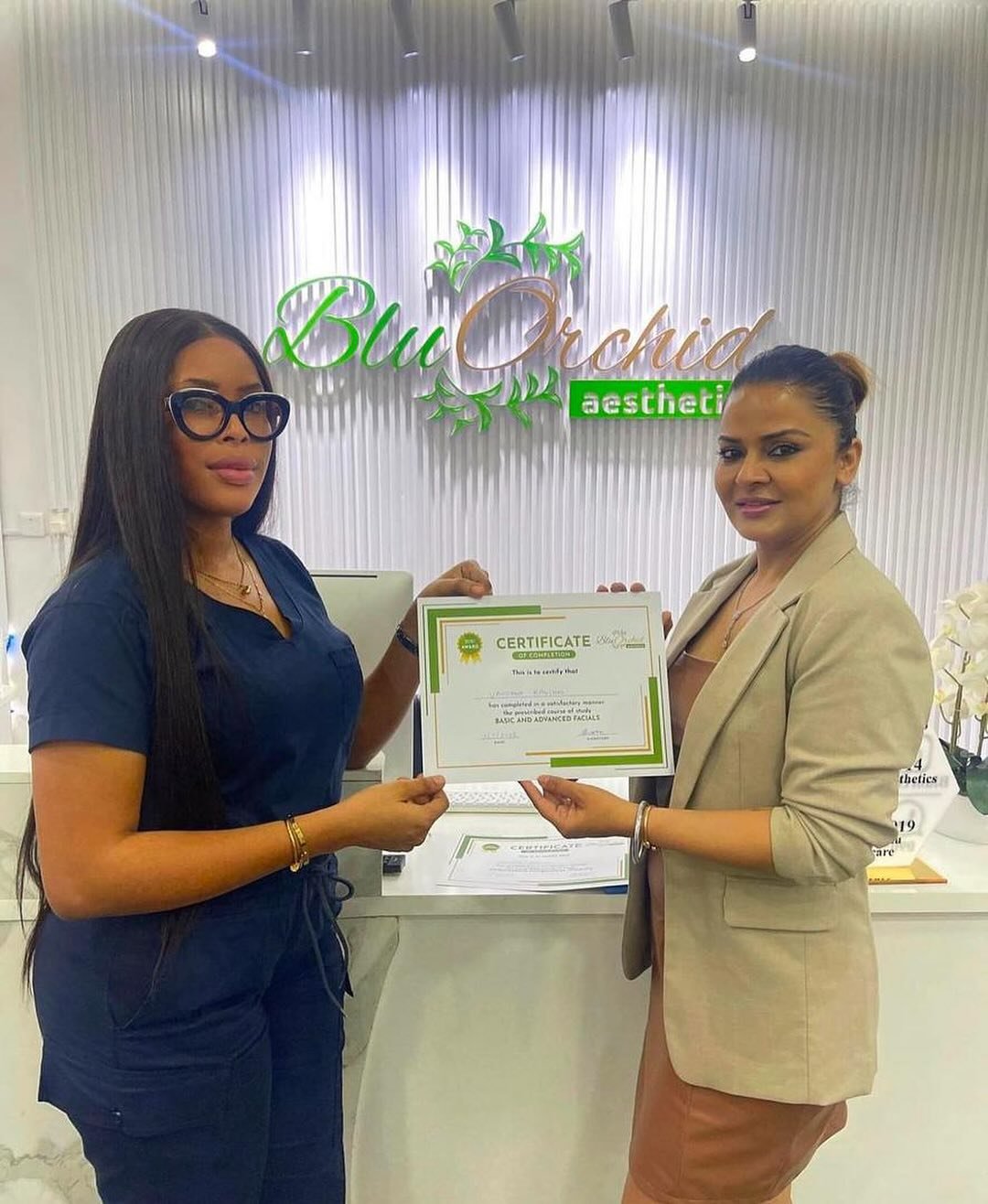
Academy at BluOrchid Aesthetics, Lagos
2. What is my professional background?
Your existing profession matters.
Doctors, nurses and other eligible healthcare professionals may have different training needs and professional scopes.
Do not choose a course simply because it accepts you.
Choose one that is appropriate for your professional background and intended practice.
3. Will I actually practise?
Ask the training provider directly:
“Will I personally perform practical procedures under supervision?”
Do not assume that “hands-on” means the same thing everywhere.
A live demonstration is not necessarily hands-on training.
4. How will I be assessed?
A strong programme should be clear about what students are expected to know and demonstrate before completion.
Ask whether the programme includes:
- Theory assessment
- Practical assessment
- Case planning
- Anatomy assessment
- Trainer feedback
- Competency evaluation
5. What happens after the course?
A certificate may mark the completion of a course.
It does not mark the end of your education.
Ask whether the academy provides opportunities for further learning, mentorship, case discussions or advanced training.
Online vs hands-on: which is better for Botox and fillers?
For injectable aesthetics, hands-on education has an important advantage because the procedures require practical skill.
Online education can teach the theory behind Botox and dermal fillers.
You can learn:
- Facial anatomy
- Muscles
- Treatment indications
- Product principles
- Patient selection
- Treatment planning
- Contraindications
- Complication theory
But learning how to apply that knowledge to a real patient requires practical education.
For an aspiring injector, a programme that combines strong theoretical teaching with supervised practical training is generally more useful than a purely online certificate.
Online vs hands-on for beginners
If you are completely new to aesthetics, online learning can be a good way to understand the field before committing to a more substantial programme.
But beginners should be particularly careful about confusing familiarity with competence.
After watching enough aesthetic videos, it is easy to feel that a procedure looks simple.
Clinical practice is different.
The human face is not a diagram.
Patients have different anatomy, proportions, histories, concerns and expectations.
A good beginner pathway should therefore build knowledge first and then introduce practical skills in an appropriate, supervised environment.
Online vs hands-on for experienced healthcare professionals
For doctors, nurses and other eligible professionals who already have a strong clinical foundation, online education can work well as supplementary learning.
An experienced professional may use online modules to:
- Learn about a new treatment
- Review anatomy
- Study a product
- Prepare for an advanced course
- Refresh theoretical knowledge
- Continue professional development
But if the objective is to develop a new procedural skill, practical training remains important.
The more advanced the procedure, the more important it becomes to consider the quality of supervision and assessment rather than simply the convenience of the course.
What makes a good hands-on aesthetics course?
Do not choose a course simply because it says “hands-on”.
Look at what is actually included.
A strong programme should make its:
Eligibility
Clear who can enrol and who the programme is not designed for.
Curriculum
Clear what students will learn and how deeply each area is covered.
Practical component
Clear what students will actually perform rather than simply observe.
Supervision
Clear who is supervising practical work and what their professional background is.
Assessment
Clear how competency is evaluated.
Safety education
Clear how complications and patient safety are addressed.
Post-course development
Clear what opportunities exist to continue learning.
These details tell you considerably more about a course than the certificate alone.
What should you be wary of?
Be cautious of aesthetics courses that rely heavily on marketing claims such as:
- “Become an injector in one weekend”
- “Master Botox instantly”
- “No experience required”
- “Start earning immediately”
- “International certificate guaranteed”
- “Learn everything online”
- “Open your aesthetics clinic after one course”
The problem is not that short courses can never be useful.
The problem is when the marketing makes a complex clinical skill appear effortless.
Good aesthetic training should respect the complexity of the work.
So, should you choose online or hands-on training?
If you are learning theory, online education can be excellent.
If you are developing practical clinical skills, hands-on education has a clear advantage.
And for someone serious about becoming an aesthetic practitioner, the strongest approach is often not online versus hands-on.
It is:
Online for knowledge. Hands-on for application. Supervision for correction. Assessment for competence. Continued education for development.
That is a more realistic way to think about aesthetics training.
Aesthetic Training at BluOrchid Academy
BluOrchid Academy offers different training pathways depending on your professional background and level of experience.
The Beginners Aesthetics Course is designed for those entering the field, while the Aesthetic Injector Program is an advanced pathway for eligible doctors, nurses and licensed medical aestheticians.
The Aesthetic Injector Program is currently priced at ₦2,500,000.
The important consideration is not simply receiving a certificate.
It is choosing training that gives you the knowledge, practical education and clinical foundation appropriate to the work you intend to do.
If you are unsure which pathway fits your background, you can Book a Consultation with the BluOrchid team before enrolling.
Frequently asked questions
Is an online aesthetics course worth it?
Yes, if you understand what it is designed to teach. Online courses can be valuable for theory, anatomy, product knowledge, treatment principles and continuing education. They should not automatically be treated as a replacement for supervised practical training.
Is hands-on aesthetics training better than online training?
For practical procedures, hands-on training offers an important advantage because students can practise skills under supervision and receive direct feedback. Online training can complement that education.
Can I learn Botox online?
You can learn the theory of Botox online, including anatomy, treatment principles, patient selection and complication education. Practical injectable skills require appropriate practical training and supervision.
Can I learn dermal fillers online?
Online courses can teach filler theory and treatment planning. However, learning practical injection technique requires appropriate hands-on education and supervision.
Do I need hands-on training to become an aesthetic injector?
If you intend to perform practical aesthetic procedures, hands-on training is an important part of developing procedural competence. The appropriate training also depends on your underlying professional qualification and scope of practice.
Are online aesthetics certificates recognised?
A certificate confirms what training you completed, but its value depends on the provider, curriculum, assessment and practical education behind it. A certificate should not be confused with professional registration or a licence to practise.
Can nurses take hands-on aesthetics training?
Some programmes accept eligible nurses. The important question is whether the nurse meets the programme’s entry requirements and whether the procedures taught are appropriate to their professional scope.
Can doctors take an advanced aesthetics course?
Yes. Advanced aesthetics programmes can be appropriate for doctors who want to develop aesthetic medicine within their existing clinical practice. The training should match their existing experience and professional goals.
How do I choose an aesthetics course in Nigeria?
Look at the entry requirements, trainers, curriculum, practical component, supervision, assessment, safety education and post-course support. Do not choose based solely on the promise of a certificate.
What is the difference between a live demonstration and hands-on training?
In a live demonstration, you observe the trainer performing a procedure. In hands-on training, you participate in practical learning and, where appropriate, perform techniques under supervision.
Does BluOrchid Academy offer hands-on aesthetics training?
BluOrchid Academy has training pathways designed around practical aesthetic education, including the Beginners Aesthetics Course and the advanced Aesthetic Injector Program for eligible professionals.
The Beginners Aesthetics Course is where this training actually happens.
Hands-on training at the BluOrchid clinic in Lekki Phase 1, Lagos, taught by the doctors who treat patients there every week. Course fee ₦800,000.
See the Beginners Aesthetics Course Small cohorts. Live models. Certificate on completion.