Why Facial Profiling Makes Better Injectors
Learn why facial profiling matters in aesthetic practice and how assessing the whole face can lead to more thoughtful treatment planning.

A patient walks into an aesthetics clinic and points to her lips.
Another points to her jawline.
Someone else asks for cheek filler because she feels her face has started to look tired.
An average injector may begin with the area the patient has identified.
A great injector starts somewhere else.
They look at the face.
Not just the lips. Not just the cheeks. Not just the jaw.
The whole face.
That distinction is at the heart of Facial Profiling, BluOrchid’s signature approach to assessing a whole face before treating any individual part of it.
Because aesthetic injecting is not simply about knowing where to place a product.
It is about understanding why a particular intervention may or may not make sense for that face.
The face is not a collection of separate parts
This sounds obvious, but it changes everything.
The lips exist in relation to the nose.
The nose exists in relation to the chin.
The chin affects the perception of the lower face.
The cheek influences how the mid-face is read.
The forehead, temples, brows, eyes and jaw all contribute to the overall balance.
When you treat one area without considering the others, you can improve that individual feature while unintentionally changing the balance of the face.
That is why a patient asking for lip filler may not necessarily need more volume in the lips.
The concern might actually be about proportion.
Or support.
Or the relationship between the lips and surrounding facial structures.
The visible complaint and the underlying aesthetic issue are not always the same thing.
A good injector needs to recognise the difference.
What is Facial Profiling?
At BluOrchid, Facial Profiling means assessing the whole face before treating any individual part of it.
It is a structured way of looking at facial proportions, relationships and balance before deciding what, if anything, should be treated.
The principle is simple:
Assess first. Plan second. Treat third.
That sounds straightforward.
In practice, it requires the practitioner to resist the temptation to immediately give the patient exactly what they asked for.
The patient may arrive asking for filler.
The consultation should determine whether filler is actually appropriate, where it might be appropriate, and whether another approach would better address the concern.
Sometimes the best aesthetic decision is not to add anything.
That is part of good aesthetic judgement.
Facial Profiling is not about making every face look the same
There is a particular danger in aesthetic medicine when “balance” becomes a template.
A practitioner sees a popular look online and begins trying to reproduce it on every patient.
The result can be technically well executed and still aesthetically wrong for the individual.
Facial Profiling starts with the opposite assumption:
Your face does not need to become someone else’s face.
The aim is to understand the patient’s own anatomy, proportions and aesthetic goals.
The question is not:
“How do I make this face look like the current ideal?”
It is:
“What would make this particular face feel more balanced while still looking like itself?”
That distinction matters enormously.
The Golden Ratio and the idea of proportion
Facial Profiling at BluOrchid includes a proportion-led assessment informed by The Golden Ratio method.
The Golden Ratio can be used as a way of thinking about proportion and relationships within facial assessment.
But it should not be treated as a rigid mathematical template that every face must conform to.
Human faces are not equations.
Ethnicity, age, anatomy, expression and individual characteristics all matter.
A thoughtful injector therefore uses proportion as part of an assessment rather than trying to force every patient into the same numerical ideal.
The objective is not mathematical perfection.
It is considered aesthetic judgement.
Why this matters when injecting
Injectables can change the way light, shadow, volume and contour are perceived.
Adding volume to one area can influence how another area appears.
That means an injector needs to understand more than the injection point.
They need to understand the face around it.
Consider a patient who believes her jawline is the problem.
The temptation might be to immediately treat the jawline.
But during a full facial assessment, the practitioner may notice that the perceived issue is influenced by the chin, lower-face proportions, soft-tissue distribution or another structural relationship.
The appropriate plan may therefore be different from the treatment the patient initially imagined.
This is where clinical reasoning becomes more important than a menu of procedures.
Great injectors ask better questions
Technique matters.
But before technique comes assessment.
A strong injector should want to understand:
- What is the patient actually concerned about?
- When did they first notice it?
- What would they like to change?
- What do they want to preserve?
- Have they had previous aesthetic treatments?
- What treatments have they had?
- What did they like or dislike about previous results?
- Are their expectations realistic?
- Is treatment appropriate at this point?
- What alternatives should be considered?
These questions move the consultation away from:
“Which treatment do you want?”
and towards:
“What are we actually trying to achieve?”
That is a much more useful question.
The difference between treatment planning and treatment shopping
Aesthetic medicine becomes very different when the consultation is treated as a treatment-planning process rather than a shopping experience.
Treatment shopping sounds like:
“I want Botox.”
“I want filler.”
“I want a sharper jawline.”
Treatment planning asks:
“What is causing the concern, what is realistically modifiable, and what is the most appropriate approach?”
The difference is subtle.
The consequences are not.
A practitioner who simply follows a treatment request can become dependent on the patient’s diagnosis of their own face.
A practitioner who profiles the face takes responsibility for making an informed clinical assessment.
Facial Profiling also means knowing what not to treat
One of the most important skills in aesthetic medicine is restraint.
Not every asymmetry needs correcting.
Not every line needs treating.
Not every face needs more volume.
Not every concern requires an injectable.
And not every patient is an appropriate candidate for a particular procedure.
A practitioner who has learned to say “not yet”, “not this treatment” or even “I would not recommend treating that” may demonstrate more clinical maturity than someone who can perform a large number of procedures.
The best aesthetic result is not necessarily the one involving the most treatment.
It is the one in which the treatment makes sense.
Why Facial Profiling matters for injectors in training
For someone learning aesthetic injecting, it can be tempting to focus almost entirely on technique.
Where should the needle go?
How much product should be used?
What angle should the injection be?
Those questions matter.
But they come later.
Before an injector can make a technically competent intervention, they need to understand the patient in front of them.
That means learning to assess:
Anatomy
A practitioner needs a strong understanding of the relevant anatomy and how individual structures relate to one another.
Proportion
They need to understand how one feature influences the perception of another.
Patient goals
They need to distinguish the patient’s desired outcome from the specific procedure they have requested.
Suitability
They need to recognise when treatment may be inappropriate or when another approach should be considered.
Treatment planning
They need to develop a coherent plan rather than treating isolated features one at a time.
Safety
They need to understand potential risks and complications relevant to the procedure and know when further assessment or escalation is required.
This is why good aesthetics education cannot be reduced to learning injection points.
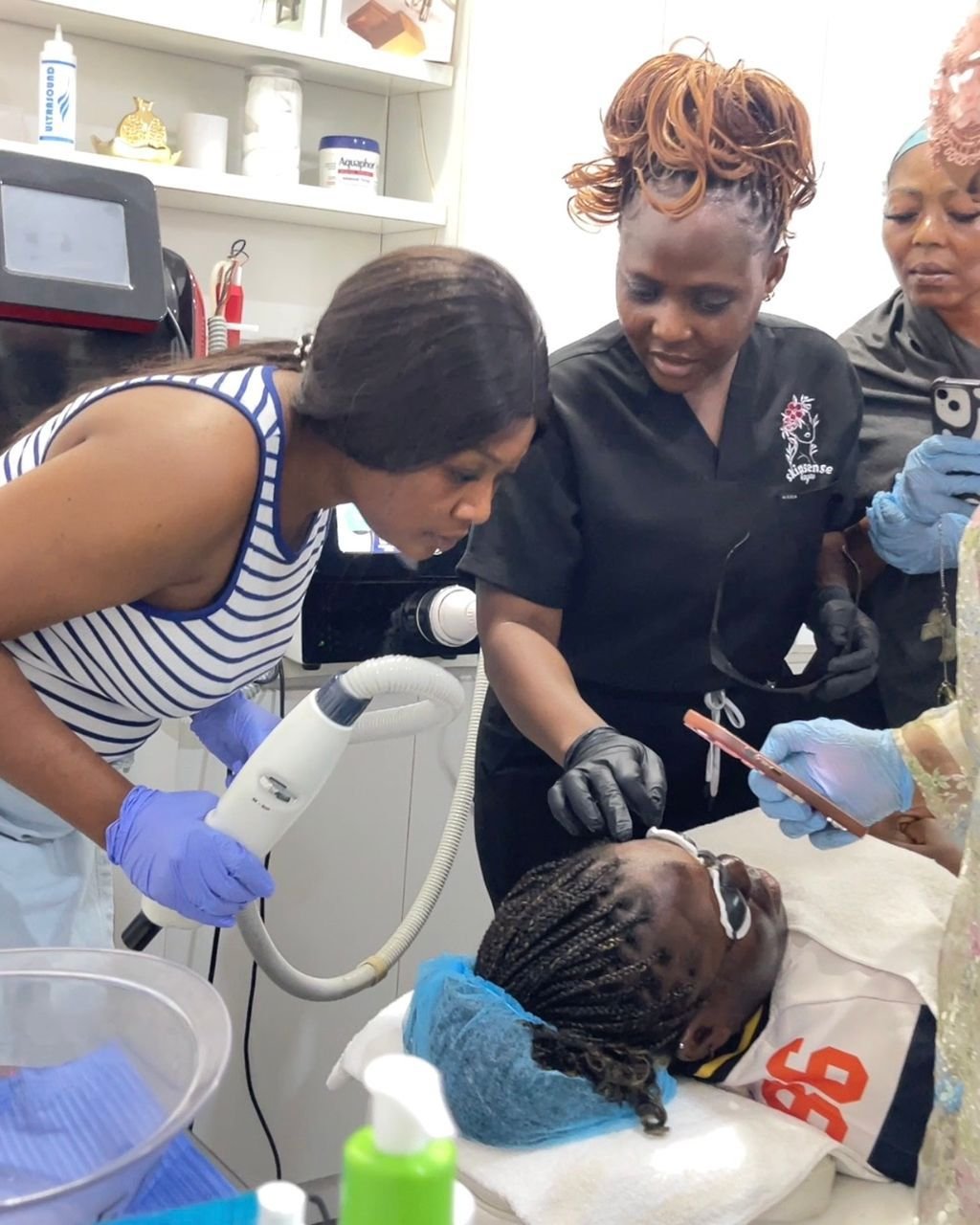
Facial profiling at BluOrchid Aesthetics, Lagos
A technically skilled injector can still produce an poor aesthetic plan
This is an important distinction.
Someone can know how to inject and still struggle to create a coherent treatment plan.
Technical competence answers:
“Can I perform this procedure?”
Clinical and aesthetic judgement asks:
“Should I perform this procedure, for this patient, in this area, at this time?”
Those are different skills.
A strong training programme should develop both.
Facial Profiling changes the consultation
When the face is assessed as a whole, the consultation becomes more strategic.
Instead of immediately discussing individual procedures, the practitioner can establish:
What is the patient’s concern?
↓
What does the facial assessment show?
↓
What is realistically achievable?
↓
What treatment options are appropriate?
↓
What should be left alone?
That process gives the patient something more valuable than a list of treatments.
It gives them a rationale.
They can understand why a treatment has been recommended rather than simply being told what to buy.
This is particularly important with injectables
Botox and dermal fillers are not interchangeable tools.
They address different concerns and work through different mechanisms.
Even within dermal fillers, different areas require different considerations.
The appropriate treatment depends on the patient’s anatomy, goals, previous treatment history and clinical assessment.
This is why “I want filler” is not enough information to create a treatment plan.
The same applies to Botox.
A patient may request Botox for a particular area because they have seen someone else treated there.
That does not mean the same approach is appropriate for their anatomy or concern.
A good injector knows the difference between a popular treatment and an appropriate treatment.
The best aesthetic practitioners do not chase trends
Beauty trends move quickly.
Facial anatomy does not.
A treatment that is fashionable today may not be the treatment a particular patient needs.
The role of a skilled injector is not to reproduce every aesthetic trend.
It is to understand the patient, assess the face and make a considered recommendation.
That is particularly important when patients arrive with screenshots of celebrities, influencers or heavily filtered images.
A practitioner should be able to translate a patient’s aspiration into a realistic conversation about what is possible for their own face.
Facial Profiling is ultimately about restraint and precision
The word “precision” is often associated with injection technique.
But precision begins before the needle.
It begins with observation.
Where is the actual concern?
What is contributing to it?
What should be preserved?
What could be improved?
What would be too much?
What would not be appropriate?
The more clearly those questions are answered, the more purposeful the treatment plan becomes.
That is the thinking behind Facial Profiling.
What Facial Profiling teaches us about becoming a better injector
If you are training to become an aesthetic injector, learning procedures is only one part of the journey.
You also need to develop the ability to see the face as a whole.
That means moving beyond:
“I know how to inject filler.”
towards:
“I understand why, where, when and whether filler is appropriate for this patient.”
That is a much higher standard.
And it is one of the reasons facial assessment deserves a central place in aesthetics education.
What should facial profiling training include?
If you are comparing aesthetics courses, ask whether facial assessment is genuinely taught or simply mentioned in the curriculum.
A strong training pathway should give practitioners an opportunity to develop their understanding of:
- Facial anatomy
- Facial proportions
- Patient consultation
- Aesthetic assessment
- Treatment planning
- Product selection
- Individualised recommendations
- Patient expectations
- Contraindications and suitability
- Complication awareness
- Ethical decision-making
- Practical application under appropriate supervision
The objective should not be to produce practitioners who can perform more procedures.
It should be to develop practitioners who can make better decisions.
The difference is in the thinking
Great injectors are not necessarily the people who treat the most areas.
They are the people who can look at a face and understand the relationship between those areas.
They know when to add.
They know when to wait.
They know when to change the plan.
And they know when doing nothing is the better decision.
That is what makes Facial Profiling more than a consultation technique.
It is a way of thinking about aesthetic medicine.
Assess the whole face. Understand the individual. Build the plan. Then treat.
That is the difference between simply knowing how to inject and knowing how to practise aesthetic medicine well.
Frequently asked questions
What is Facial Profiling in aesthetics?
Facial Profiling is a whole-face assessment performed before deciding which individual features, if any, should be treated. At BluOrchid, it is a signature method built around understanding facial proportions, relationships, patient goals and appropriate treatment planning.
Why is facial assessment important before Botox or fillers?
Because the feature a patient wants to change may be influenced by surrounding structures. Assessing the whole face helps the practitioner understand the concern in context and determine whether the requested treatment is appropriate.
What is The Golden Ratio method in facial aesthetics?
The Golden Ratio method is a proportion-led framework used within facial assessment. It can help a practitioner think about relationships between facial features, but it should not be treated as a rigid template that every face must match.
Does Facial Profiling mean every patient gets treatment?
No. A proper assessment may lead to a recommendation for treatment, a different treatment, a staged approach or no treatment at all.
Is Facial Profiling the same as facial mapping?
The terms can overlap depending on how an individual practitioner uses them. Facial Profiling at BluOrchid refers specifically to the broader assessment of the whole face before deciding how individual areas should be approached.
Can Facial Profiling be learned?
Yes. Facial assessment, anatomy, proportion, consultation and treatment planning can all form part of professional aesthetics education. Practical training and appropriate supervision are particularly important for practitioners learning injectable procedures.
Why is facial profiling important for aesthetic injectors?
It helps shift the focus from simply performing procedures to understanding why a particular treatment may be appropriate for a particular patient. This supports more individualised treatment planning.
What should I look for in facial profiling training?
Look for training that covers anatomy, facial assessment, proportion, consultation, treatment planning, patient suitability, product knowledge, safety and supervised practical learning where appropriate.
Does facial profiling guarantee a natural-looking result?
No technique can guarantee a particular outcome. Facial Profiling is intended to support thoughtful assessment and individualised planning, but aesthetic results depend on many factors, including the patient’s anatomy, treatment choice, practitioner judgement and response to treatment.
Where can I learn facial profiling in Nigeria?
If you are a healthcare professional interested in developing your aesthetic assessment and injectable skills, you can review the training pathways available through BluOrchid Academy and discuss which educational pathway is appropriate for your professional background.
Interested in learning the thinking behind aesthetic injecting?
If your goal is to become a more thoughtful and technically competent aesthetic practitioner, the right training should teach you more than where to place a needle.
It should teach you how to assess the patient sitting in front of you.
Book a Consultation to discuss your goals and the appropriate BluOrchid training pathway.
The Aesthetic Injector Program is where this training actually happens.
Hands-on training at the BluOrchid clinic in Lekki Phase 1, Lagos, taught by the doctors who treat patients there every week. Course fee ₦2,500,000.
See the Aesthetic Injector Program Small cohorts. Live models. Certificate on completion.