Facial Asymmetry: What Can Be Corrected Without Surgery
Facial asymmetry is normal, but some differences can be softened without surgery. Learn what Botox, filler and facial profiling can change.

Look closely at almost any face and you will find some degree of asymmetry.
One eyebrow may sit slightly higher.
One side of the smile may move differently.
One cheek may appear fuller.
The chin may sit a little off-centre.
The jawline may be more defined on one side than the other.
This is normal.
In fact, trying to make a face perfectly symmetrical is neither realistic nor necessarily desirable.
But some asymmetries can become more noticeable with age, changes in facial volume, muscle activity, dental or skeletal differences, previous injury, or simply the way the face has developed.
And that raises a very common question:
Can facial asymmetry be corrected without surgery?
Sometimes, yes.
But the answer depends entirely on what is causing the asymmetry in the first place.
A carefully placed injectable can sometimes soften a difference in muscle activity, restore volume or improve the visual balance of a feature.
It cannot, however, change every underlying bone, muscle, dental or neurological problem.
That distinction is where good facial assessment begins.
What is facial asymmetry?
Facial asymmetry means that the two sides of the face are not identical.
This can involve differences in:
- Eyebrow position
- Eye shape or height
- Cheek volume
- Nose position
- Lip position
- Smile movement
- Chin position
- Jawline shape
- Facial width
- Soft-tissue volume
Some asymmetry is present from childhood.
Some develops gradually.
And some can appear more obvious after changes such as weight loss, ageing or dental treatment.
The important point is that asymmetry is not automatically a problem that needs correcting.
A small difference between the two sides is part of what makes a face look human rather than manufactured.
Is facial asymmetry normal?
Yes.
Almost everyone has some degree of facial asymmetry.
Even when a face looks symmetrical at first glance, closer examination will usually reveal differences between the two sides.
The goal of aesthetic treatment is therefore not to create mathematical symmetry.
It is to decide whether a particular asymmetry is noticeable enough to bother you and whether it can be improved safely.
Sometimes a small adjustment can make a meaningful difference.
Sometimes trying to correct a minor asymmetry can make the face look less natural.
What causes facial asymmetry?
There is no single cause.
The asymmetry may come from several different structures.
Bone structure
The underlying facial skeleton can naturally differ from one side to the other.
Differences in the jaw, chin, cheekbones or other facial structures can influence the appearance of the entire face.
Dermal filler cannot reshape the underlying bone permanently.
It can sometimes create a visual improvement by adding volume in carefully selected areas.
Muscle activity
Muscles on the two sides of the face do not always behave identically.
This can be particularly noticeable around the eyebrows, jaw and lower face.
For certain forms of muscular asymmetry, botulinum toxin can be used to reduce muscle activity selectively.
The objective is not to “freeze” the face.
It is to create a more balanced relationship between the two sides.
Facial volume
The two sides of the face may have different amounts or distribution of soft-tissue volume.
This can be naturally occurring or become more obvious after ageing or weight loss.
In appropriate cases, dermal filler can restore volume to a specific area.
Ageing
Ageing does not necessarily affect both sides of the face identically.
Changes in skin elasticity, fat distribution and soft-tissue support can make existing differences more noticeable.
Dental or jaw relationships
The position of the teeth and jaws can influence how the lower face sits.
A chin that appears off-centre, for example, may be related to the underlying jaw rather than simply a problem with soft tissue.
This is one reason a clinician should not assume that every facial asymmetry is an injectable problem.
Previous injury or surgery
Trauma, surgery or scarring can alter the shape or movement of one side of the face.
Depending on the cause, treatment may require a combination of aesthetic and medical assessment.
Nerve or neurological conditions
Sudden facial asymmetry is different from longstanding cosmetic asymmetry.
A new drooping mouth, weakness on one side of the face, difficulty speaking, arm weakness or other sudden neurological symptoms can be a medical emergency rather than an aesthetic concern.
If facial asymmetry develops suddenly, particularly alongside other neurological symptoms, seek urgent medical attention rather than booking an aesthetic treatment.
Can facial asymmetry be corrected without surgery?
Sometimes it can be improved, rather than completely corrected.
That distinction matters.
Non-surgical aesthetic treatments generally work by changing soft tissue, muscle activity or visual proportions.
They do not reconstruct the underlying skeleton.
The most appropriate treatment depends on what is creating the visible difference.
Botox for muscular asymmetry
Botulinum toxin can reduce excessive or uneven muscle activity.
This may be relevant when one side of the face is being pulled or contracted more strongly than the other.
Depending on the area, treatment may influence:
- Brow position
- Certain lower-face muscle patterns
- Jaw muscle prominence
- Other forms of dynamic asymmetry
The treatment must be carefully planned because weakening the wrong muscle, or weakening it too much, can create a new asymmetry.
This is why Botox for facial asymmetry is not simply a matter of injecting the weaker-looking side.
The clinician needs to understand the movement pattern first.
Can filler correct facial asymmetry?
Dermal filler can sometimes improve asymmetry caused by differences in soft-tissue volume or projection.
For example, if one side of the cheek has less volume than the other, carefully placed filler may create greater visual balance.
Similarly, selected patients may benefit from small adjustments to the chin or jawline where differences in projection contribute to an uneven appearance.
But filler does not “fix” the underlying cause in every case.
If the asymmetry is caused by bone structure, dental alignment or significant skeletal differences, adding soft-tissue volume may only partially change what you see.
And more filler is not necessarily the answer.
The goal is usually strategic correction, not filling everything until both sides look identical.
What about an asymmetrical chin?
An uneven-looking chin can have several causes.
It may be:
- Slightly off-centre
- More projected on one side
- Affected by differences in surrounding soft tissue
- Influenced by the underlying jaw
- More noticeable because of changes in facial volume
If the difference is primarily related to soft-tissue volume or projection, filler may sometimes improve the appearance.
If the underlying issue is skeletal, however, filler has limitations.
This is why the chin should be assessed as part of the entire facial profile rather than treated in isolation.
A small change to chin projection can influence how the nose, lips and jawline appear in relation to one another.
What about an uneven jawline?
An uneven jawline can also have several explanations.
One side may appear wider because of muscle development.
There may be differences in the underlying bone.
One side may have more soft-tissue volume.
Or the apparent asymmetry may actually originate from the chin.
In selected cases, Botox may be useful when the difference is related to muscle bulk, while filler may be considered when additional structure or volume could improve the contour.
The important word is selected.
A jawline that looks uneven in a photograph does not automatically tell you what needs to be treated.
Can facial profiling help with asymmetry?
Yes, and this is often the most important step.
Facial profiling is not simply looking at a face and deciding where to inject.
It is an assessment of how the different features relate to one another.
When asymmetry is the concern, the clinician may consider:
- The face from the front
- The profile
- Oblique views
- Facial movement
- Chin position
- Jawline shape
- Cheek volume
- Muscle activity
- Overall facial proportions
This helps distinguish between true asymmetry and an apparent asymmetry created by another feature.
For example, a chin that appears off-centre may look more balanced after a small adjustment elsewhere rather than by adding significant volume directly to the chin.
That is why the treatment plan should follow the assessment.
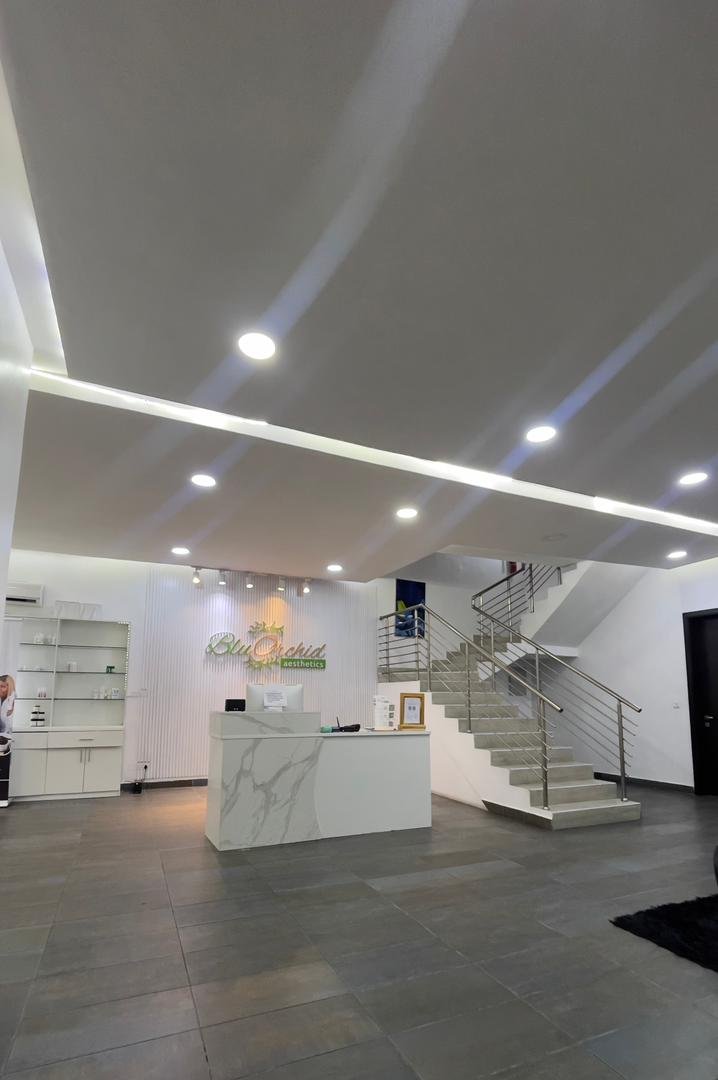
Brand at BluOrchid Aesthetics, Lagos
Why “fixing” one side can sometimes make things worse
Imagine that one side of the face looks smaller.
The instinct may be to add volume to that side.
But what if the apparent difference is actually caused by the other side being more prominent?
Or what if the difference comes from muscle activity rather than volume?
Adding filler without understanding the cause could make the imbalance more noticeable.
The same applies to Botox.
If the underlying movement pattern is misunderstood, reducing muscle activity on the wrong side can create a new difference.
Good asymmetry correction therefore requires restraint.
The question is not:
“How do we make this side look exactly like the other?”
It is:
“Why do these sides look different, and what is the smallest appropriate intervention that could improve the balance?”
Can facial asymmetry be corrected with Botox and filler together?
Sometimes.
Different causes can coexist.
For example, one side of the lower face may have greater muscle activity while another area has less soft-tissue volume.
In such a situation, a combination approach may be considered.
But combination treatment should not mean treating every difference you can identify.
The more interventions you add, the more important the overall treatment plan becomes.
The objective remains balance.
When non-surgical treatment may not be enough
There are situations where filler or Botox is unlikely to provide the structural change someone wants.
These can include significant skeletal asymmetry, substantial jaw differences, major post-traumatic changes or certain dental and functional problems.
In these cases, a clinician may recommend assessment by another appropriate medical or dental specialist.
This is not a failure of aesthetic treatment.
It is good treatment planning.
A responsible clinician should be comfortable saying:
“This is not something an injectable can adequately correct.”
Facial asymmetry after weight loss
Significant weight loss can make existing asymmetries more noticeable.
If one side of the face naturally carried more soft-tissue volume than the other, losing facial fat can reveal that difference more clearly.
This can be particularly noticeable through the cheeks, temples and lower face.
The answer is not necessarily to restore all lost volume.
Instead, the clinician should assess whether the asymmetry represents a meaningful change in facial proportions and whether selective treatment could improve it.
This is particularly relevant when facial changes occur after substantial weight loss.
What should you look for in facial asymmetry treatment before and after photos?
Before-and-after photographs can be useful, but they should be interpreted carefully.
Look for:
Consistent angles
The head should be positioned similarly in the before and after photographs.
Similar lighting
Changes in shadows can make one side of the face look fuller or more defined.
The same facial expression
A smile, eyebrow movement or jaw position can dramatically change apparent asymmetry.
The entire face
Do not judge the treatment only by the area that was injected.
Ask whether the overall face appears more balanced.
Subtlety
The best result may not be the photograph with the most dramatic change.
It may be the one where the asymmetry is simply less distracting.
What happens during a facial asymmetry consultation?
A good consultation should begin with questions rather than injections.
Your clinician may ask:
- When did you first notice the asymmetry?
- Has it always been present?
- Has it changed recently?
- Does it become more noticeable when you smile or speak?
- Have you had previous injury or surgery?
- Have you experienced significant weight loss?
- Are you concerned about the front view, profile or both?
The face can then be assessed at rest and, where relevant, during movement.
Only after the cause and treatment possibilities are understood should a treatment plan be considered.
Is facial asymmetry treatment permanent?
That depends on the treatment.
Botulinum toxin produces a temporary reduction in muscle activity.
Most commonly used dermal fillers are also temporary and are gradually broken down by the body.
Surgical procedures can create more durable structural changes.
The appropriate option depends on the underlying cause and the degree of correction required.
What are the risks of treating facial asymmetry?
The risks depend on the treatment being considered.
With Botox, temporary bruising, tenderness or unintended muscle weakness can occur. An imprecise treatment can also create or worsen asymmetry.
With dermal filler, swelling, bruising, tenderness and temporary lumps can occur. More serious complications can occur if filler is inadvertently introduced into a blood vessel. These can include tissue injury and, very rarely, visual impairment or stroke. (fda.gov)
This is why facial anatomy, appropriate patient selection and clinical experience matter.
The risk-benefit discussion should happen before treatment, not after.
Frequently asked questions
Is facial asymmetry normal?
Yes. Most faces have some degree of natural asymmetry. Treatment is generally considered when the difference is noticeable to the person and can be improved safely.
Can facial asymmetry be fixed without surgery?
Some types can be improved without surgery. Botox may help selected muscular asymmetries, while dermal filler may help selected differences in soft-tissue volume or projection. Structural skeletal asymmetry may require a different approach.
Can Botox fix an uneven face?
It can help in selected cases where differences in muscle activity contribute to the asymmetry. It cannot correct every type of facial asymmetry.
Can filler fix an asymmetrical face?
Filler can sometimes improve asymmetry caused by differences in soft-tissue volume or projection. It cannot reproduce every structural change caused by bone or dental differences.
Can chin filler correct an asymmetrical chin?
Sometimes. If the difference is primarily related to soft-tissue volume or projection, carefully planned filler may improve the appearance. Significant skeletal asymmetry may require another approach.
Can jawline filler fix an uneven jaw?
It may improve selected soft-tissue contour differences. However, an uneven jawline can have muscular, skeletal or dental causes, so the cause should be assessed before treatment.
Why does my face look more asymmetrical in photos?
Camera angle, lighting, lens distortion, head position and facial expression can all affect how asymmetry appears. A clinical assessment should not be based on a single photograph.
Should I treat facial asymmetry?
Not necessarily. Some asymmetry is completely normal. Treatment should be considered only if the difference genuinely concerns you and an appropriate clinician believes it can be improved safely.
What if my facial asymmetry appeared suddenly?
Sudden facial weakness or drooping can be a sign of a medical condition rather than an aesthetic issue. If facial asymmetry appears suddenly, especially with difficulty speaking, weakness or numbness, seek urgent medical attention.
The goal is balance, not perfection
There is a subtle but important difference between correcting asymmetry and trying to make both sides identical.
Human faces are not perfectly symmetrical.
The aim of good aesthetic treatment is not to erase every difference. It is to understand what is creating the imbalance and determine whether a subtle intervention could make the face feel more harmonious.
Sometimes that may be Botox.
Sometimes it may be filler.
Sometimes it may be a combination.
And sometimes the right answer is to leave it alone or seek another form of medical assessment.
At BluOrchid Aesthetics, facial enhancement begins with understanding the face as a whole rather than treating an isolated feature.
If facial asymmetry is something you would like assessed, you can Book a Consultation to discuss what may be contributing to the difference and whether non-surgical treatment is appropriate.
The consultation fee is ₦50,000 and is credited towards your selected treatment if you decide to proceed.
A consultation at BluOrchid begins with exactly this assessment.
One hour with our doctors. An honest assessment. A plan built around you. ₦50,000, credited in full toward your first treatment.
Book your consultation Doctor-led assessment at Lekki Phase 1, Lagos.