Vampire Facial: What PRP Really Does for Your Skin
What does a vampire facial actually do? Learn how PRP works, its potential benefits for acne scars and skin quality, and what it cannot do.


The name sounds dramatic.
The treatment itself is much more straightforward.
A vampire facial is a cosmetic treatment involving platelet-rich plasma, or PRP, usually combined with a skin procedure such as microneedling.
The idea is not that blood is somehow rejuvenating the face simply because it is blood.
The relevant part is the platelet-rich plasma derived from your own blood.
And that distinction matters.
PRP is increasingly used alongside procedures that create controlled injury to the skin, particularly microneedling. For acne scars, the American Academy of Dermatology describes PRP as an adjunct that may enhance the results of another treatment such as microneedling.
So what does PRP actually do?
What is PRP?
PRP stands for platelet-rich plasma.
A small amount of your blood is collected and processed to separate the plasma and concentrate platelets.
Platelets are best known for their role in blood clotting, but they also contain biological signalling substances involved in tissue repair.
In aesthetic medicine, PRP is used with the intention of supporting the skin’s healing and remodelling response.
The important point is that PRP is not a filler.
It does not work by physically filling an acne scar.
It is also not the same thing as Botox, a skin booster or a chemical peel.
It is a biological material prepared from the patient’s own blood and used as part of a treatment protocol.
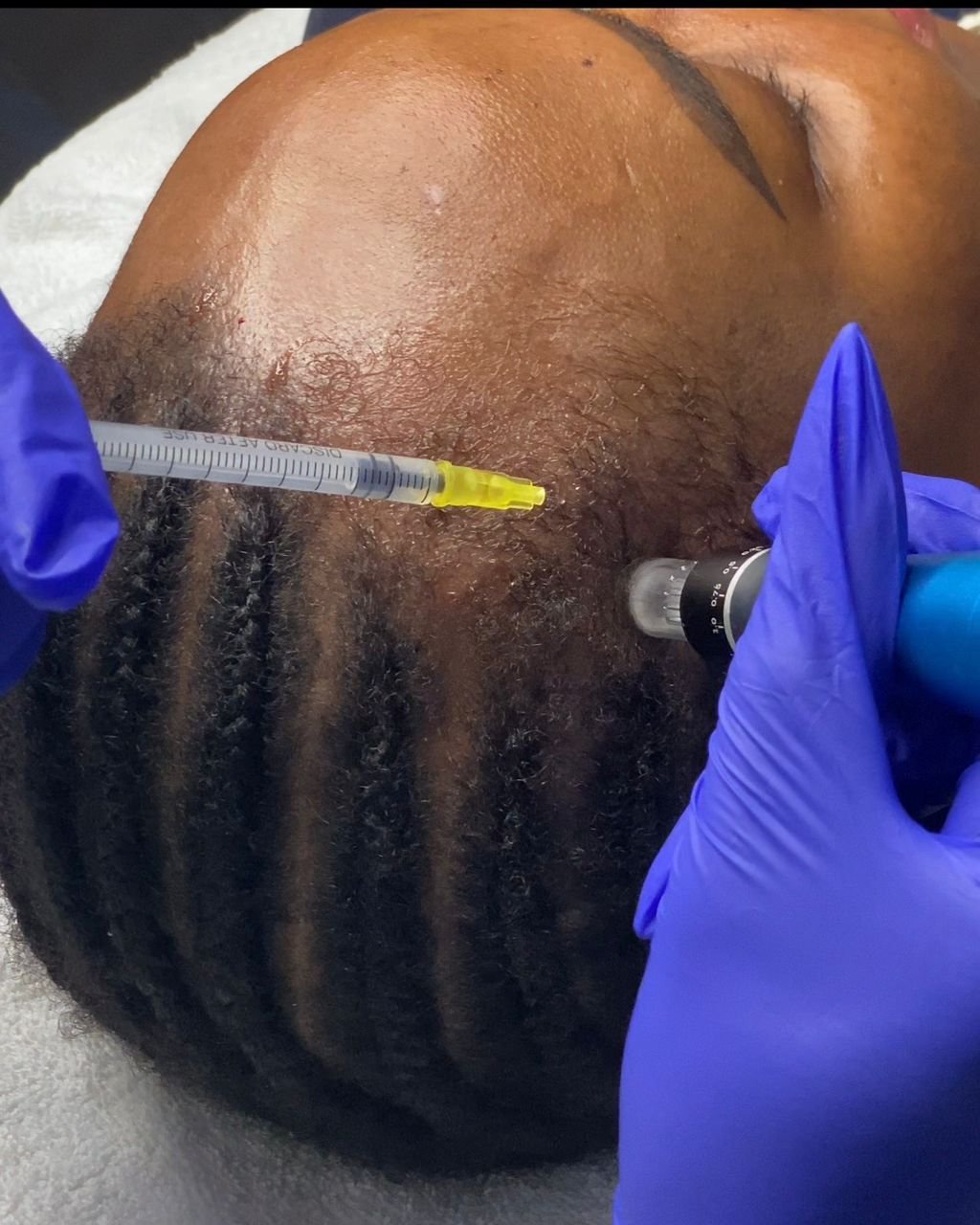
So why is it called a “vampire facial”?
The term is largely a cosmetic nickname.
It became popular because blood is drawn from the patient and the resulting PRP is applied to or introduced into the skin during the treatment.
The name makes the procedure sound more mysterious than it really is.
In clinical terms, the more useful description is:
PRP used with a skin-rejuvenation or collagen-remodelling procedure.
At BluOrchid, the Vampire Facial is listed within the microneedling treatment offering, alongside PRX microneedling. The current site pricing lists Vampire Facial from ₦215,000.
What actually happens during a Vampire Facial?
The exact protocol can vary depending on the clinic and treatment plan, but a typical PRP-based facial involves several stages.
1. Blood is drawn
A small amount of your blood is collected.
2. The blood is processed
The sample is placed into a centrifuge or other processing system designed to separate its components and produce a platelet-rich fraction.
3. The skin is prepared
The face is cleansed and prepared for the procedure.
Depending on the protocol, a topical anaesthetic may be used to improve comfort.
4. Microneedling or another procedure is performed
For acne scars and texture concerns, PRP is commonly combined with microneedling.
Microneedling creates controlled micro-injuries in the skin, stimulating a wound-healing response and new collagen and elastin production.
5. PRP is used as part of the treatment
The PRP may be applied to the treated skin or introduced through an appropriate technique depending on the clinical protocol.
This is why calling it simply a “blood facial” misses the important part.
The treatment is about PRP and the procedure used alongside it, not blood itself.
What does PRP actually do to the skin?
This is where the marketing around vampire facials can become excessive.
PRP is not a magic growth serum.
Its proposed role is to support the biological processes involved in tissue repair and regeneration.
When used with microneedling, there are essentially two components:
Microneedling creates controlled micro-injury and stimulates collagen remodelling.
PRP provides a concentrated platelet-containing preparation intended to support the healing response.
The two treatments can therefore complement each other.
The American Academy of Dermatology specifically notes that microneedling is often combined with treatments such as PRP to improve results, and that studies show PRP combined with another treatment can lead to less visible acne scarring.
Can a Vampire Facial improve acne scars?
Potentially, yes, but the wording matters.
PRP is not a universal acne-scar remover.
The evidence is more supportive of PRP as an adjunct to procedures such as microneedling than as a standalone treatment that magically fills or erases scars.
Recent evidence continues to support combination approaches in atrophic acne scars. A 2026 systematic review and network meta-analysis found that combination treatments generally performed better than single treatments across moderate-to-severe atrophic acne scars, with microneedling combined with PRP among the combinations showing favourable rankings for significant improvement. The authors also stressed that treatment selection should account for scar type, skin phototype, downtime, adverse-effect risk and patient preference.
That is a much more useful way to understand PRP.
It is part of a treatment strategy, not the entire strategy.
Which acne scars can PRP help?
PRP may be incorporated into treatment plans for atrophic acne scars, particularly when it is combined with a procedure designed to remodel the scarred skin.
But not all acne scars are structurally identical.
You might have:
- Ice-pick scars
- Boxcar scars
- Rolling scars
- Mixed scars
- Acne scars combined with pigmentation
A treatment that works well for one scar pattern may not be appropriate for another.
For example, a deeply tethered rolling scar may require a treatment that addresses the tethering itself. A deep ice-pick scar may require a more targeted technique.
PRP does not change that underlying anatomy.
It may support the treatment, but it does not replace correct scar assessment.
What about microneedling with PRP?
This is one of the most commonly discussed uses of PRP in aesthetic dermatology.
Microneedling creates controlled micro-injuries.
The skin responds by producing new collagen and elastin.
PRP is then used as an adjunct to the microneedling treatment.
The American Academy of Dermatology describes this combination as one approach that may improve acne-scar outcomes.
The important distinction is:
Microneedling is doing the collagen-induction work.
PRP is being used to support or enhance the treatment response.
That is very different from saying that PRP alone “builds new skin” or “fills scars.”
Does PRP literally fill acne scars?
No.
PRP is not a volumising filler.
If an acne scar is a physical depression caused by loss of tissue or tethering, PRP does not simply inject volume into that space in the way a dermal filler can.
Its proposed role is biological: supporting healing and tissue remodelling.
That is why the treatment plan still needs to be based on the structure of the scar.
Can PRP improve skin texture?
It may.
When PRP is combined with treatments such as microneedling, the goal can include improving:
- Skin texture
- Unevenness
- The appearance of some acne scars
- Fine lines
- Overall skin quality
But “skin quality” is deliberately different from promising a dramatic transformation.
The outcome depends on the patient’s starting skin, treatment protocol and the condition being treated.
Does a Vampire Facial make you look younger?
This is where the phrase “vampire facial” can create unrealistic expectations.
PRP is often marketed as a rejuvenation treatment, but there is no single, predictable “younger-looking” result that everyone will experience.
If the treatment is being used for skin quality, the objective may be gradual improvement in texture and overall appearance.
If it is being used alongside microneedling for acne scars, the objective is more specific: reduce the visibility of depressed scarring through collagen remodelling.
Those are different treatment goals.
Laser at BluOrchid Aesthetics, Lagos
Is PRP better than microneedling alone?
Not necessarily in every patient.
Some studies suggest that adding PRP to microneedling or other scar procedures can improve outcomes compared with the procedure alone.
The AAD also recognises PRP as an adjunct to treatments such as microneedling for acne scars.
But that does not mean:
PRP + microneedling = automatically better for everyone.
The benefit depends on the indication, protocol, scar type and individual patient.
A 2026 review of acne-scar treatments found that combination approaches generally performed well, but also emphasised that the evidence base remains heterogeneous and that treatment selection should be individualised.
What about PRP for dark skin?
People with darker skin can undergo microneedling and PRP-based treatments.
Microneedling itself is considered safe for all skin tones when appropriately performed.
But darker skin can be more prone to post-inflammatory hyperpigmentation after skin injury or inflammation.
That means the question should not simply be:
“Can I have a Vampire Facial?”
It should be:
“Is this treatment appropriate for my skin, and how should the protocol be adapted to minimise unnecessary inflammation?”
This is particularly important when treating someone who already has pigmentation following acne.
What are the risks?
PRP uses material derived from your own blood, but that does not mean the procedure is risk-free.
The risks depend on how the treatment is performed and what other procedure is being used alongside it.
With microneedling, you may experience temporary:
- Redness
- Swelling
- Tenderness
- Mild irritation
- Pinpoint bleeding
There is also a risk of infection or unwanted pigmentation if procedures are performed inappropriately.
If blood is being drawn and processed, there are additional considerations around sterile technique and safe handling of blood products.
The AAD recommends discussing your medical history and previous acne treatments before undergoing acne-scar procedures. Some scar treatments may be inappropriate while using or shortly after certain acne medications.
Is there downtime?
There can be some downtime, particularly because the Vampire Facial commonly involves microneedling.
Immediately after treatment, the skin may appear:
- Red
- Warm
- Slightly swollen
- More sensitive than usual
The amount and duration of visible recovery vary according to the treatment intensity and individual skin response.
This is another reason not to treat “Vampire Facial” as a standardised procedure.
Two clinics may use the same marketing name while delivering meaningfully different protocols.
Is a Vampire Facial suitable for active acne?
Not automatically.
If you have active, inflamed or painful acne, the priority may be to control the acne rather than immediately perform a collagen-induction procedure.
Continuing to develop inflammatory acne also means continuing to risk new scars.
The AAD recommends getting active acne under control before beginning scar treatment in many situations.
A consultation should therefore assess both:
the acne you have now
and
the scars your previous acne has left behind.
How many Vampire Facial treatments do you need?
There is no universal number.
The treatment schedule depends on:
- Why you are having PRP
- The severity of the concern
- Scar type
- The accompanying procedure
- Your skin’s response
- The clinician’s treatment plan
Acne-scar treatment often requires a series rather than a single procedure, particularly when collagen remodelling is the goal.
It is therefore better to think in terms of a treatment plan rather than a one-off facial.
Vampire Facial vs ordinary facial
These treatments should not be confused.
A conventional facial may involve cleansing, exfoliation, extraction, masks or other cosmetic skin treatments.
A Vampire Facial is a medical aesthetic procedure involving PRP, commonly combined with microneedling.
The goals are therefore different.
A regular facial may be selected for cleansing, hydration or general skin maintenance.
A PRP-based treatment may be considered when the goal involves skin remodelling, texture or selected acne-scar concerns.
Vampire Facial vs microneedling
The two are related but not identical.
Microneedling: Uses controlled needle injury to stimulate collagen production.
Vampire Facial: Typically combines PRP with a procedure such as microneedling.
So when someone asks:
“Should I have microneedling or a Vampire Facial?”
the more accurate question is:
“Would adding PRP to my microneedling treatment be appropriate for my skin and treatment goal?”
That is a clinical decision, not simply an upgrade from one facial to another.
Vampire Facial vs PRX
PRX and PRP are also completely different.
PRP uses a platelet-rich preparation derived from the patient’s own blood.
PRX is a specialised peel-based treatment.
They should not be presented as different versions of the same treatment.
Depending on the skin concern, scar type and treatment objective, a clinician may consider one, the other or a different treatment altogether.
What PRP cannot do
It is just as important to understand the limits.
PRP cannot guarantee:
- Complete removal of acne scars
- Perfectly smooth skin
- Permanent pore reduction
- Permanent tightening
- A specific number of years removed from your appearance
- The same result seen in another patient
And it should not be marketed as a “miracle” treatment.
The best use of PRP is as a clinically considered component of a broader treatment plan when the evidence and the patient’s skin make that approach reasonable.
Frequently asked questions
Is a Vampire Facial the same as PRP?
A Vampire Facial is a popular cosmetic term for a treatment involving platelet-rich plasma. In aesthetic practice, PRP is commonly combined with microneedling or another skin procedure.
Does a Vampire Facial remove acne scars?
It may help improve the appearance of some acne scars, particularly when PRP is used alongside a treatment such as microneedling. It does not guarantee complete scar removal.
Does PRP fill acne scars?
No. PRP is not a dermal filler. Its proposed role is to support healing and tissue remodelling rather than physically filling a depressed scar.
Is PRP better than microneedling?
Not automatically. PRP is commonly used as an adjunct to microneedling, and some evidence suggests the combination can improve outcomes, but the appropriate treatment depends on the patient’s skin and scar characteristics.
Is a Vampire Facial painful?
The experience varies. Microneedling can cause discomfort, which is why clinics may use topical anaesthesia or other comfort measures depending on the protocol.
Can people with dark skin have a Vampire Facial?
Yes, but treatment should be planned carefully. Any procedure that creates inflammation or controlled injury can potentially contribute to pigmentation changes, so skin type and pigmentation history should be considered.
How long does it take to see results?
Collagen remodelling is gradual. If PRP is being used alongside microneedling for acne scars, improvement is generally assessed over time rather than immediately after the appointment.
Can I have PRP if I still have acne?
You should be assessed first. Active inflammatory acne may need to be controlled before scar-focused procedures are considered.
The bottom line
The Vampire Facial is not magic, and it is not simply about putting blood on your face.
PRP is a platelet-rich preparation derived from your own blood and used in aesthetic medicine to support tissue healing and remodelling.
For acne scars, its strongest practical role is often as an adjunct to another treatment such as microneedling, rather than as a standalone scar eraser.
Microneedling creates the controlled injury that stimulates collagen production.
PRP may help support that response.
Whether that combination is appropriate depends on your scar type, active acne status, skin characteristics and treatment goals.
At BluOrchid Aesthetics, Vampire Facial is offered as part of the clinic’s microneedling treatment options. If you are considering PRP for acne scars or skin quality, book a consultation so your skin can be assessed before a treatment plan is recommended.
A consultation at BluOrchid begins with exactly this assessment.
One hour with our doctors. An honest assessment. A plan built around you. ₦50,000, credited in full toward your first treatment.
Book your consultation Doctor-led assessment at Lekki Phase 1, Lagos.