Skin Boosters vs Fillers: What Is the Difference?
Skin boosters vs fillers explained: how they differ, what each treatment is designed to do, and which may suit hydration, skin quality or volume.


If you are considering injectable aesthetics, you may have come across two terms that sound deceptively similar:
Skin boosters.
Dermal fillers.
Both can involve injectable hyaluronic acid. Both are used in aesthetic medicine. And both can be used to improve the appearance of ageing skin.
So what is actually different?
The simplest answer is this:
Skin boosters are generally used to improve skin quality, while dermal fillers are primarily used to restore or add volume and shape.
But the distinction is more nuanced than that.
Some products used as skin boosters are technically injectable fillers with different physical properties and different injection techniques. The term “skin booster” itself is not a single standardized product category.
That is why the question should not simply be, “Which one is better?”
It should be:
“What are you actually trying to change?”
Skin boosters vs fillers at a glance
| Item | Skin Boosters | Dermal Fillers |
|---|---|---|
| Main objective | Improve skin quality | Restore or add volume and contour |
| Primary concerns | Hydration, texture, fine lines, overall skin quality | Volume loss, facial contours, selected folds and depressions |
| Typical approach | Often placed more superficially or within the skin | Placement depends on the area and desired correction |
| Intended effect | Fresher, smoother, more hydrated-looking skin | Shape, structure and volume restoration |
| Can use hyaluronic acid? | Yes, commonly | Yes, commonly |
| Creates significant facial volume? | Usually not the primary objective | Often yes |
| Replaces lost facial structure? | No | Can, depending on the treatment |
| Best thought of as | Skin-quality treatment | Structural/volume treatment |
The exact product, formulation, injection depth and technique matter. Not every treatment marketed as a “skin booster” works in exactly the same way.
What are skin boosters?
“Skin booster” is a broad term used for injectable treatments designed primarily to improve skin quality rather than facial shape.
Hyaluronic acid is one of the most widely used materials in this category.
Unlike traditional volumizing fillers, some HA skin boosters are formulated and delivered to emphasize hydration and skin-quality effects rather than creating obvious projection or contour. Reviews describe injectable skin boosters as a diverse category that can include different biological materials and formulations.
Depending on the specific product and technique, the intended improvements may include:
- Hydration
- Skin smoothness
- Fine lines
- Elasticity
- Texture
- Overall skin quality
- A fresher-looking complexion
A systematic review of injectable hyaluronic acid found evidence of improvements in measures of facial skin quality including hydration, firmness, brightness, texture, radiance and elasticity, although larger controlled studies are still needed.
The key point is that a skin booster is generally trying to make the skin itself look and feel better.
It is not primarily trying to reshape your face.
What are dermal fillers?
Dermal fillers are injectable materials used to restore or add volume in specific areas.
Hyaluronic acid is one of the best-known filler materials, although dermal fillers are not limited to one material.
Depending on the product and treatment area, fillers can be used to address concerns such as:
- Loss of facial volume
- Lip volume
- Chin projection
- Cheek volume
- Jawline definition
- Selected facial folds or depressions
- Facial proportion and contour
The goal is usually more structural.
Instead of asking:
“How can I make my skin look more hydrated?”
the treatment question may be:
“Where has volume or definition been lost, and how can that be restored appropriately?”
This is why fillers can be particularly useful when the concern is about facial architecture rather than skin quality alone.
The biggest difference: skin quality vs facial structure
Imagine two people looking in the mirror.
The first person says:
“My skin looks tired, dry and less smooth than it used to.”
That is primarily a skin-quality concern.
The second says:
“My cheeks have lost volume and my face no longer has the same structure.”
That is more of a volume and structural concern.
These people may both benefit from injectable treatment.
But they are not asking the same question.
A skin booster may be considered when the objective is improving skin quality.
A filler may be considered when the objective is restoring or modifying volume and contour.
And in some cases, the two approaches may be used as part of a broader treatment plan.
Does a skin booster add volume?
This is where the terminology can become confusing.
Some skin boosters contain hyaluronic acid, and hyaluronic acid naturally attracts and holds water.
So there can be some degree of tissue hydration and fullness.
But that does not mean a skin booster is equivalent to a conventional volumizing filler.
The formulation, degree of cross-linking, particle characteristics, concentration, injection plane and technique can all influence how an injectable behaves in tissue. Reviews describe lower-cross-linked or non-cross-linked HA formulations as having different volumizing characteristics from more conventional cross-linked HA fillers.
The important distinction is therefore intended effect, not simply whether the injectable contains HA.
Lip filler at BluOrchid Aesthetics, Lagos
Can fillers improve skin quality too?
Yes.
This is another reason the two categories should not be treated as completely separate worlds.
Research has shown that injectable HA can have effects beyond simple volume replacement, including effects on hydration and aspects of skin quality.
Some filler formulations and techniques are also used specifically to influence skin quality.
So saying:
“Fillers are only for volume.”
would be too simplistic.
The better distinction is:
Traditional volumizing filler treatment primarily addresses structure and volume, while skin-booster treatment primarily targets skin quality.
Which is better for dry skin?
If the main complaint is that your skin looks or feels dehydrated, a skin-quality treatment may be more relevant than a traditional volumizing filler.
But injectable treatment should not automatically be the first answer to every case of dry skin.
Your skincare routine, skin barrier, environmental exposure and underlying skin condition all matter.
A medical aesthetic consultation should establish what is actually causing the concern before choosing an injectable treatment.
Which is better for fine lines?
It depends on why the fine lines are there.
Fine lines can be influenced by:
- Skin hydration
- Skin quality
- Repeated muscle movement
- Sun exposure
- Loss of elasticity
- Volume changes
- Skin laxity
A skin booster may be considered when the concern is primarily skin quality.
A filler may be appropriate for certain lines or depressions where volume support is relevant.
Other treatments may be more appropriate when muscle movement is the dominant cause.
There is no universal injectable for “fine lines.”
Which is better for facial volume loss?
This is where dermal fillers generally have the clearer role.
If the concern is genuine loss of volume or definition, for example, certain areas of the cheeks, lips or chin, a volumizing filler may be considered depending on the patient’s anatomy and treatment goals.
A skin booster should not be presented as a substitute for structural volume restoration.
If the underlying problem is loss of facial volume, improving hydration alone does not recreate the same structural correction.
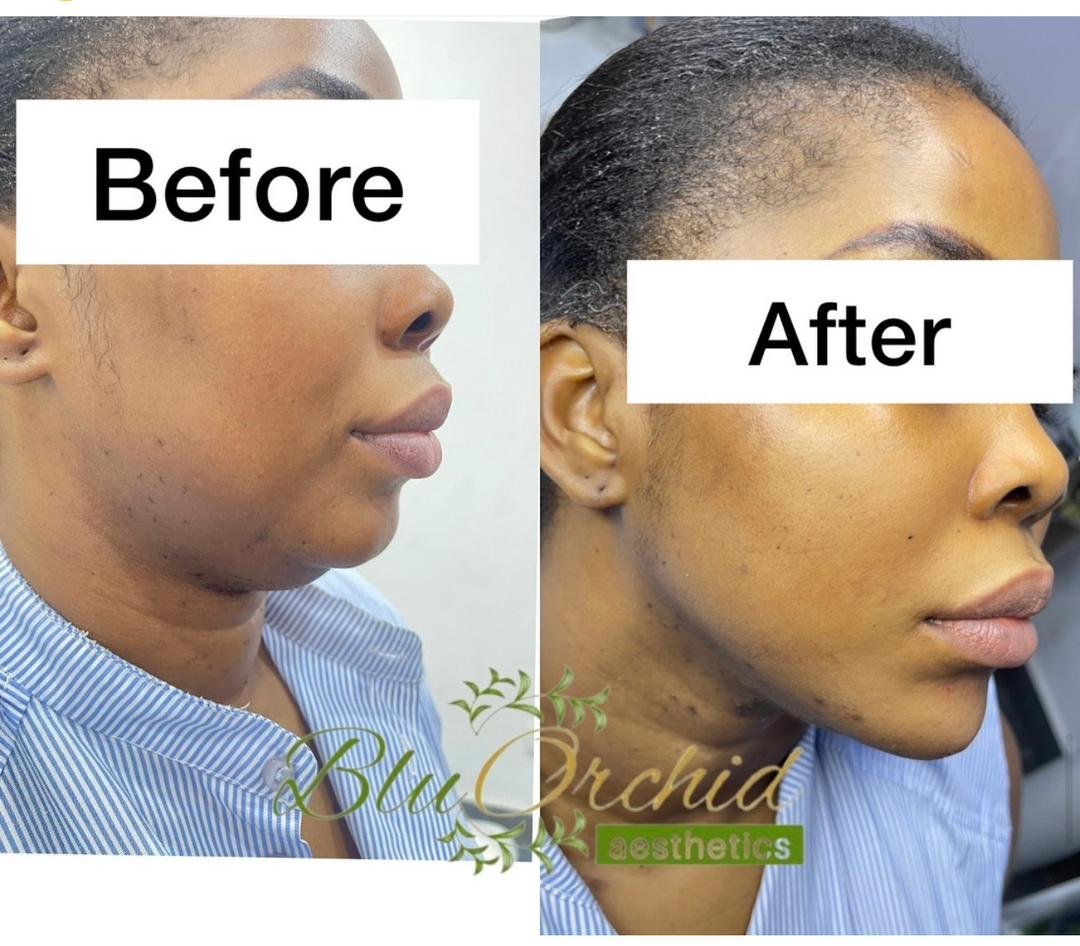
Which is better for facial contouring?
Dermal fillers.
If your goal is to influence facial proportions or create more definition in a specific area, fillers may be considered because they can provide controlled volume and contour.
This is particularly relevant when treatment is based on facial proportions rather than simply treating an isolated wrinkle.
Skin boosters are generally not designed to reshape the face.
Which gives the most natural-looking result?
Neither treatment is automatically more natural.
The result depends on:
- The patient’s anatomy
- The treatment objective
- Product selection
- Amount used
- Injection technique
- Placement
- Practitioner experience
- Whether the treatment is actually necessary
A natural-looking result does not necessarily mean using less product.
It means using the right intervention for the right anatomical problem.
A patient who needs subtle skin-quality improvement may look unnatural if they are given unnecessary volume.
Likewise, someone with significant volume loss may not achieve their desired result from a skin-quality treatment alone.
Can you have skin boosters and fillers together?
Sometimes.
Because they address different aspects of facial ageing, a clinician may consider both in an overall treatment plan.
For example, one treatment may address skin quality while another addresses a specific structural or volume concern.
But combining treatments should not become an automatic formula.
More treatment is not necessarily better treatment.
The objective should always be to identify what actually needs changing and treat that appropriately.
What about dark skin?
Skin boosters and fillers can both be used in people with darker skin.
But skin of colour still requires thoughtful assessment.
Any injectable procedure can cause temporary inflammation, swelling or bruising, and inflammation can sometimes contribute to post-inflammatory hyperpigmentation in susceptible individuals.
The treatment plan should therefore take into account:
- Your history of pigmentation
- Previous reactions to procedures
- Current skin condition
- The area being treated
- Product selection
- Injection technique
- Aftercare
The goal is not to avoid injectable treatments because you have dark skin.
It is to avoid unnecessary trauma and choose an appropriate treatment plan for your skin.
Are skin boosters safer than fillers?
Not necessarily.
It would be misleading to say that one category is simply “safe” while the other is “unsafe.”
Both involve injections.
Both can produce temporary effects such as swelling and bruising.
And injectable aesthetic treatments can have complications that require appropriate clinical management.
Risk depends on the product, anatomical area, injection technique, practitioner training and patient factors.
Skin boosters are not risk-free simply because they are designed to improve skin quality rather than add obvious volume.
Recent reviews also highlight the lack of standardization across skin-booster products and protocols, which makes broad claims about the entire category difficult.
What happens if you choose the wrong treatment?
This is perhaps the most useful way to think about the difference.
If your problem is skin quality but you choose a volumizing treatment
You may be addressing something that was not the primary problem.
Adding volume does not automatically correct dehydration, roughness or poor skin quality.
If your problem is volume loss but you choose only a skin booster
You may improve the quality of the skin without adequately restoring the underlying volume or contour.
If the concern is actually muscle movement
Neither treatment may be the most appropriate first-line option.
If the concern is pigmentation
An injectable treatment may not address the underlying cause at all.
This is why an assessment matters more than choosing a treatment because it is currently popular.
Skin boosters vs fillers: which one do I need?
Use the goal, rather than the name of the treatment, as your starting point.
You may be discussing a skin booster if your main concern is:
- Dehydrated-looking skin
- Dullness
- Fine surface lines
- Reduced skin elasticity
- Uneven texture
- Overall skin quality
You may be discussing dermal fillers if your main concern is:
- Lost facial volume
- Lip volume
- Chin projection
- Cheek definition
- Jawline definition
- Facial contour
- A specific depression or fold where volume support is appropriate
You may need something else if your concern is:
- Dynamic wrinkles
- Active acne
- Significant pigmentation
- Acne scarring
- Skin laxity
- Excess facial fat
That is why a good consultation does not begin with:
“Which injectable do you want?”
It begins with:
“What are you trying to change?”
A simple way to remember the difference
Think of the face as having two different layers of the problem.
Skin quality: How does the skin look and behave?
Facial structure: How is the face shaped and supported?
Skin boosters are generally more concerned with the first.
Dermal fillers are generally more concerned with the second.
There can be overlap, but the treatment objective remains different.
Frequently asked questions
Are skin boosters the same as fillers?
No, but there is significant overlap. Many skin boosters use injectable hyaluronic acid formulations that belong to the broader family of injectable aesthetic products. The term “skin booster” describes an intended use and category rather than one standardized product.
Do skin boosters add volume?
They can produce some fullness through hydration and the properties of the injected material, but significant facial contouring is generally not their primary objective.
Do fillers improve skin quality?
Some fillers and injection techniques can influence aspects of skin quality as well as volume. The distinction is primarily about the treatment objective and formulation.
Are skin boosters better than fillers?
Neither is universally better. They are designed to address different concerns.
Are skin boosters good for wrinkles?
They may improve the appearance of fine surface lines associated with skin quality, but not every wrinkle has the same cause. Some wrinkles may be related to muscle movement, volume loss or other structural changes.
Are fillers good for wrinkles?
They can be appropriate for certain folds or depressions where volume support is relevant, but they are not the answer to every type of wrinkle.
Can skin boosters make my face look bigger?
Depending on the product and technique, injectable HA can produce some tissue fullness. However, skin boosters are generally intended to improve skin quality rather than create pronounced facial volume.
Can I have fillers and skin boosters at the same time?
They may sometimes be incorporated into the same overall treatment plan, but whether that is appropriate depends on your anatomy, concerns, products and treatment goals.
How long do skin boosters last?
There is no single answer because “skin booster” covers different products and protocols. Published reviews report variable durations depending on the material, formulation and treatment protocol.
Which is better for dark skin?
Neither is automatically better because of skin tone. The appropriate choice depends on the concern being treated and your individual history, including whether you are prone to pigmentation after inflammation.
The bottom line
Skin boosters and dermal fillers are not interchangeable, even though they can involve similar injectable materials.
A skin booster is generally about improving the quality of the skin, hydration, texture, elasticity and overall appearance.
A dermal filler is generally about restoring or adding volume and structure, helping to shape, support or rebalance selected areas of the face.
And sometimes the answer is neither.
The most natural aesthetic work begins by identifying what has actually changed in your face, rather than choosing an injectable simply because it is popular.
At BluOrchid Aesthetics, the appropriate treatment can be determined through a consultation and assessment of your facial structure, skin quality and individual goals.
A consultation at BluOrchid begins with exactly this assessment.
One hour with our doctors. An honest assessment. A plan built around you. ₦50,000, credited in full toward your first treatment.
Book your consultation Doctor-led assessment at Lekki Phase 1, Lagos.