Non-Surgical Nose Job: Threads vs Filler vs Surgery
Threads, filler or rhinoplasty? Compare non-surgical nose job options, what each can change, their limitations and how to choose safely.

The nose sits at the centre of the face, so even a relatively subtle change can alter the way the entire face is perceived.
That is why choosing a nose enhancement is not simply a question of asking which treatment is “best”. Threads, dermal filler and surgical rhinoplasty work in fundamentally different ways. They offer different degrees of change, different levels of invasiveness and, importantly, different answers to the question: what are you actually trying to change?
A non-surgical nose job can be appealing if you want refinement without traditional surgery. But “non-surgical” does not mean risk-free, and neither threads nor filler can reproduce everything that surgical rhinoplasty can achieve.
The right choice begins with the anatomy of your nose and the result you want, not the treatment that happens to be trending.
What does “non-surgical nose job” actually mean?
The phrase is commonly used to describe procedures that alter the appearance of the nose without conventional rhinoplasty.
Two approaches you may encounter are:
- Nose threads, usually dissolvable threads placed beneath the skin to provide lift or definition.
- Nose filler, sometimes called a liquid rhinoplasty, where dermal filler is strategically placed to alter the appearance of the nasal contour.
Surgical rhinoplasty is different. It involves operating on the underlying structures of the nose, including bone and cartilage, to reshape, reduce or otherwise modify the nose.
So although all three can be discussed in the same conversation, they are not interchangeable treatments.
Threads vs filler vs surgery: the fundamental difference
The simplest way to understand the three options is to think about what each treatment is capable of doing.
| Option | What it primarily does | Level of intervention | Best suited to |
|---|---|---|---|
| Nose threads | Provides lift and subtle contour definition | Minimally invasive | Selected patients wanting a subtle, temporary lift or refinement |
| Nose filler | Adds volume to alter contours and create the appearance of a straighter or more balanced profile | Injectable | Selected patients with contour concerns that can be improved by adding volume |
| Rhinoplasty | Reshapes the underlying nasal structures | Surgical | Patients seeking structural, significant or permanent change |
The important point is that adding structure and removing structure are completely different things.
Filler, for example, adds volume. It cannot literally remove a nasal hump or make a large nose smaller. Surgical rhinoplasty can alter the underlying framework of the nose, which gives it a much broader range of possibilities.
Nose threads: what can they actually do?
A thread-based nose lift uses dissolvable threads placed beneath the skin to create support, lift or definition.
For the right patient, this may produce a subtle change in the appearance of the nose without the incisions and structural surgery associated with rhinoplasty.
But the word lift is important.
Threads are not a replacement for surgical rhinoplasty. They are better understood as a minimally invasive option for selected aesthetic concerns rather than a way to completely redesign the nose.
Thread-based nose lifts can also have complications. These can include infection, thread extrusion and visible or palpable tracks or scarring. Results are temporary, and the degree of reshaping is limited compared with surgery.
Threads may be worth discussing if:
- You want a relatively subtle change.
- Your main concern involves lift or definition.
- You are not looking for a major structural transformation.
- You understand that the result is temporary.
- Your anatomy is suitable for the technique.
Threads may not be the right answer if:
- You want the nose to be significantly smaller.
- You want major structural reshaping.
- You have functional breathing concerns.
- You are expecting a surgical result without surgery.
This distinction matters because disappointment often comes from choosing a procedure based on its name rather than what it can realistically accomplish.
Nose filler: the “liquid rhinoplasty” option
Nose filler works differently.
Rather than physically lifting the nasal structure with threads, filler adds volume to carefully selected areas.
That can sometimes be used to create the appearance of a straighter bridge, improve certain contour irregularities or enhance definition.
For example, adding volume around a small dorsal hump can sometimes make the profile appear smoother. The important caveat is that the filler has not removed the hump. It has changed the surrounding contour.
That means a nose treated with filler can actually become slightly larger overall, even when the profile appears straighter.
This is one of the most important things to understand about a non-surgical nose job: filler can camouflage certain features, but it cannot reduce the underlying size of the nose.
Filler can be considered for selected concerns such as:
- Minor contour irregularities.
- Certain dorsal depressions.
- Creating the appearance of a straighter profile.
- Selected tip or bridge definition.
- Some asymmetries where adding volume can improve visual balance.
But it is not suitable for every nose.
Someone whose primary concern is that their nose is too large, too wide or structurally prominent may need a different conversation.
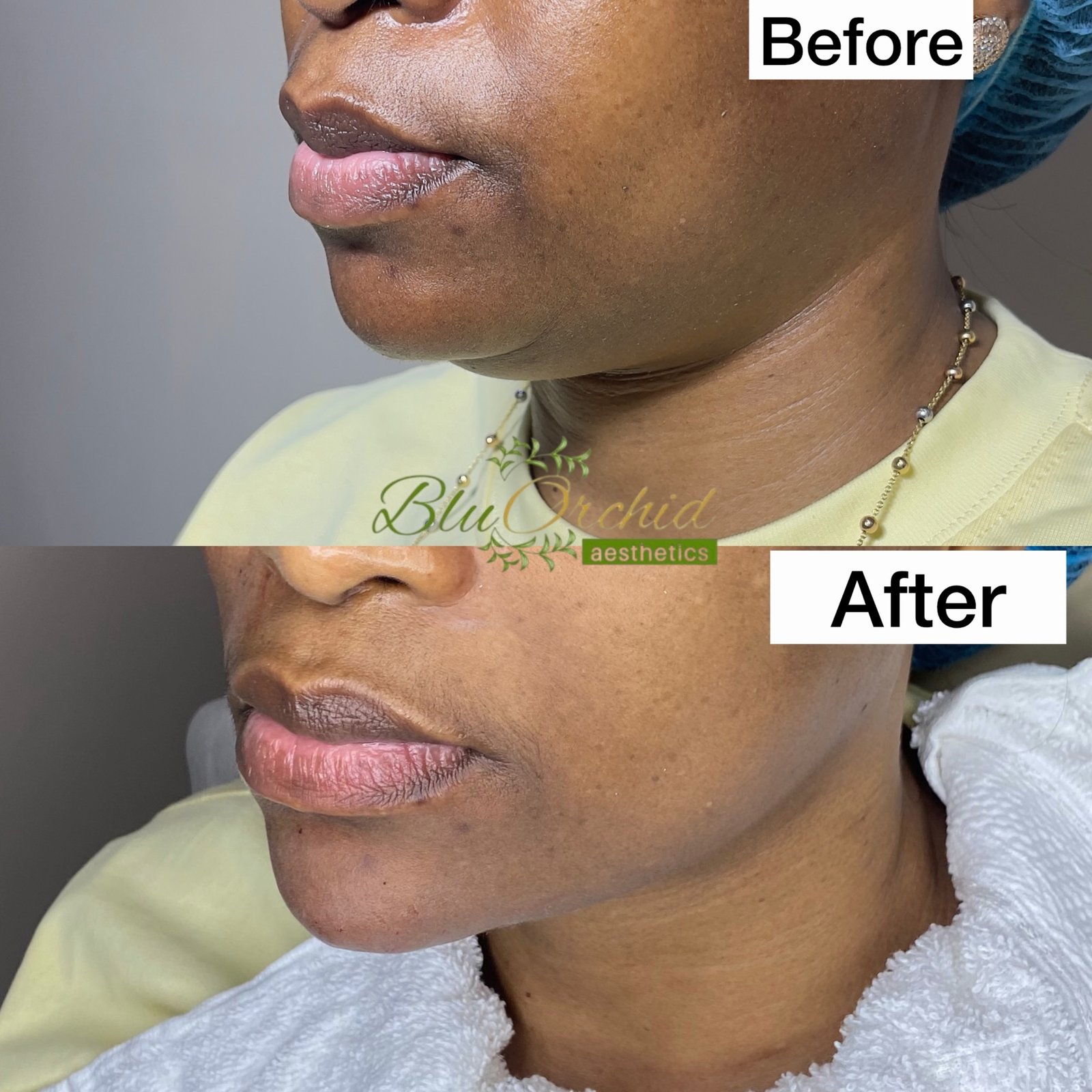
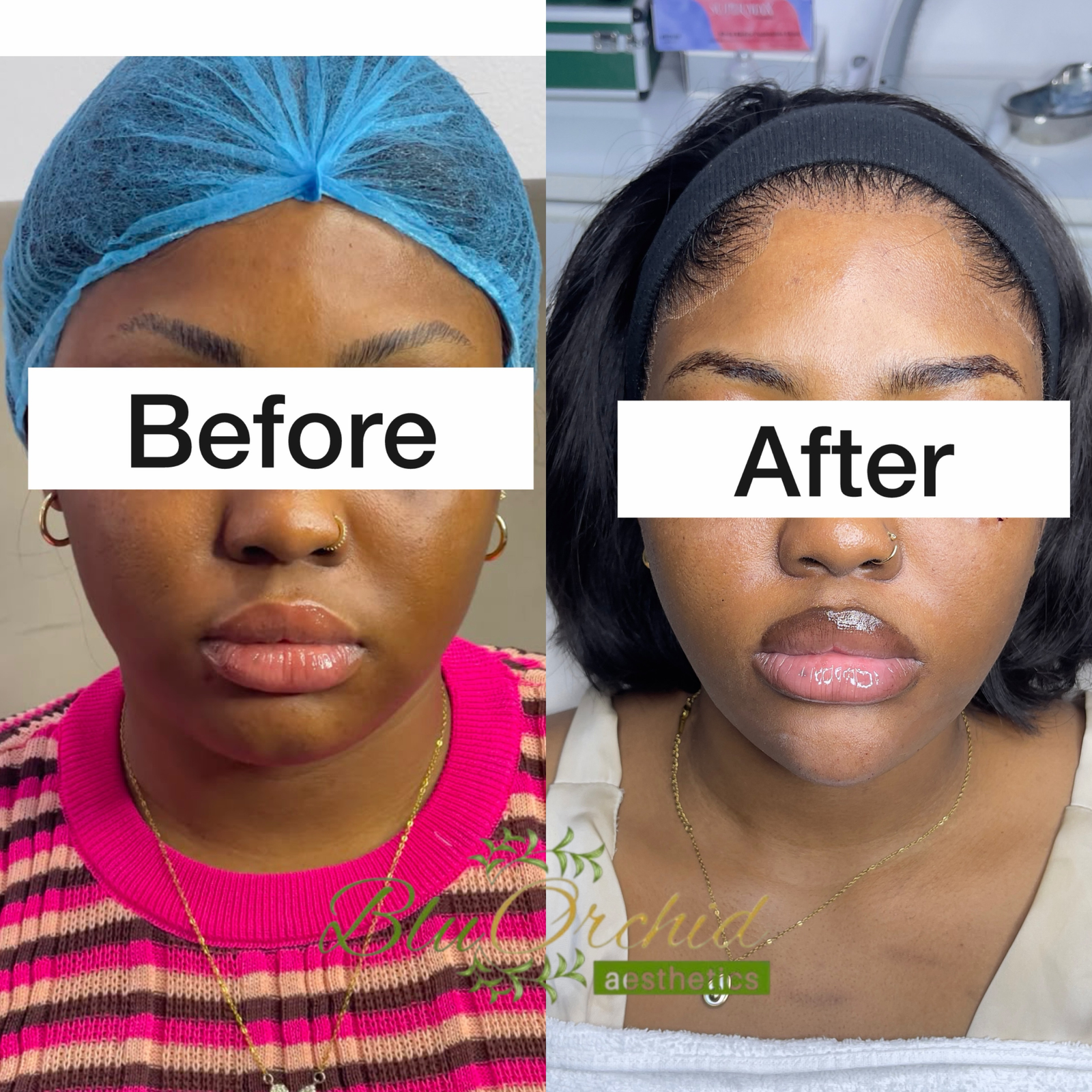
Lip filler at BluOrchid Aesthetics, Lagos
Why nose filler requires particular caution
The nose is a high-risk area for dermal filler injections because of its blood supply.
If filler unintentionally enters a blood vessel, it can compromise blood flow and, in rare cases, cause tissue necrosis or serious visual complications, including blindness. The FDA specifically warns about these potentially serious complications from accidental vascular injection.
This is why “non-surgical” should never be interpreted as “minor” or “risk-free”.
The practitioner performing the treatment matters enormously. A proper consultation should include an assessment of your anatomy, your goals, whether filler is appropriate at all, and what the clinic’s emergency protocol is if a complication occurs.
What about surgical rhinoplasty?
Rhinoplasty is the option with the greatest ability to change the actual structure of the nose.
Unlike filler, surgery can reduce bone or cartilage, alter the nasal framework and address structural concerns. It can also be used in some cases where breathing problems are related to nasal structure.
That makes surgery the more appropriate discussion when the goal is a substantial structural change rather than a subtle visual refinement.
For example, someone who wants:
- A smaller nose.
- A narrower nose.
- Significant reduction of a hump.
- Major reshaping of the nasal tip.
- Structural correction.
- Improvement of certain breathing problems.
may be better suited to a surgical assessment than a non-surgical treatment.
That does not automatically mean surgery is “better”. It means surgery is capable of doing things that non-surgical techniques cannot.
Non-surgical nose job vs rhinoplasty: which is right for you?
There is no universal winner.
The better question is:
Which procedure can realistically produce the change you want?
If your goal is subtle contour refinement and you are comfortable with a temporary result, a non-surgical approach may be worth discussing.
If you want a more significant change in the size or structure of your nose, rhinoplasty may be the more appropriate route.
And sometimes the most appropriate answer is to do nothing.
A good aesthetic consultation should not begin with “Which treatment do you want?”
It should begin with:
“What is it about your nose that you would like to change?”
That distinction allows the practitioner to work backwards from your anatomy and desired outcome rather than trying to make your desired treatment fit your face.

Can you have filler or threads before rhinoplasty?
This is a question worth asking before proceeding with any non-surgical nose treatment if you think you may eventually want surgery.
Previous filler does not automatically mean that rhinoplasty is impossible. However, your surgeon needs to know about previous treatments and assess the nose accordingly. Depending on the circumstances, filler may be dissolved or managed during the surgical process.
Threads also need to be disclosed during a surgical consultation.
If you are already considering rhinoplasty, it is sensible to discuss that possibility before committing to repeated non-surgical treatments.
Which option gives the most natural-looking result?
“Natural” is not synonymous with “non-surgical”.
A natural-looking result comes from choosing an intervention that is appropriate for your anatomy and using enough, rather than too much, to achieve the intended change.
This is particularly important with facial enhancement.
A nose should not be assessed in isolation. The bridge, tip, chin, lips, cheeks and overall facial proportions all influence how the nose is perceived.
That is why facial profiling can be useful when the question is not simply “How do I change my nose?” but rather:
“How should my nose relate to the rest of my face?”
What should you ask before having a non-surgical nose job?
Before agreeing to threads or filler, ask:
- What exactly are we changing?
- Can this treatment actually achieve the result I want?
- Will the treatment add volume or reduce it?
- How long should I expect the result to last?
- What are the specific risks for my anatomy?
- What happens if I do not like the result?
- What is the plan if a complication occurs?
- If I eventually want rhinoplasty, will this treatment affect that decision?
- Who will perform the procedure, and what relevant training do they have?
A reputable practitioner should be comfortable telling you when a particular treatment is not appropriate.
That can be more valuable than being told that every concern can be treated.
The bottom line
Threads, filler and rhinoplasty are not three versions of the same procedure.
Threads can provide selected patients with subtle lift and definition.
Filler can alter the appearance of certain contours by adding volume, but it cannot make the nose smaller and carries important vascular risks because of the anatomy of the nose.
Rhinoplasty can change the underlying nasal structure and therefore offers a much wider range of structural changes, including reduction and correction of certain functional concerns.
The most sophisticated approach is not to ask which option is most popular.
It is to ask which option is appropriate for your anatomy, your goals and the degree of change you actually want.
If you are considering a non-surgical nose lift in Lagos, you can book a consultation with BluOrchid Aesthetics to have your facial proportions and treatment options assessed before deciding on a procedure.
Frequently Asked Questions
Is a non-surgical nose job better than rhinoplasty?
Not necessarily. They address different goals. A non-surgical approach may suit someone seeking subtle contour refinement, while rhinoplasty is capable of making structural changes that threads and filler cannot.
Can nose filler make my nose smaller?
No. Filler adds volume. It can sometimes make a nose appear straighter or more balanced by changing its contours, but it cannot remove nasal tissue or reduce the underlying size.
Are nose threads permanent?
No. Nose thread lifts use dissolvable threads, so the result is temporary rather than equivalent to permanent surgical reshaping.
Is nose filler safe?
Nose filler can be performed safely in appropriately selected patients by suitably trained practitioners, but the nose is considered a higher-risk area for filler because of its vascular anatomy. Rare complications can include tissue necrosis and serious visual complications.
Can I have rhinoplasty after nose filler?
Previous filler does not automatically prevent future rhinoplasty, but it should always be disclosed to the surgeon. The surgeon can determine how previous treatment should be managed before or during surgery.
Does a non-surgical nose job improve breathing?
It should not be viewed as a substitute for surgery when the concern is a structural breathing problem. Surgical rhinoplasty, sometimes combined with septal surgery, can address certain structural causes of impaired breathing.
How do I know whether threads, filler or surgery is right for me?
Start with the change you want rather than the treatment you have seen online. A clinical assessment can determine whether your goal is realistically achievable with a non-surgical technique or whether surgical rhinoplasty would be more appropriate.
A consultation at BluOrchid begins with exactly this assessment.
One hour with our doctors. An honest assessment. A plan built around you. ₦50,000, credited in full toward your first treatment.
Book your consultation Doctor-led assessment at Lekki Phase 1, Lagos.