How to Repair Skin After Bleaching: What to Expect
Learn how to repair skin after years of bleaching, what can recover, realistic timelines, and when professional treatment may be needed.


If you have used bleaching or aggressive skin-lightening products for years, you may eventually reach a point where you no longer recognise your skin.
It may feel more sensitive than it used to.
Products that once seemed fine suddenly sting.
You may notice uneven pigmentation, persistent dark patches, lighter areas, breakouts or a complexion that reacts to almost everything.
And often, there is another question underneath all of it:
Can my skin actually recover?
In many cases, the answer is yes.
But recovery is not the same as simply finding another cream to reverse everything quickly.
After years of aggressive skin-lightening, your skin may need time, consistency and a completely different approach to care.
Some changes can improve significantly.
Some may take much longer.
And some changes may require professional assessment and treatment.
The first step is understanding what happened to your skin in the first place.
What Long-Term Bleaching Can Do to the Skin
“Bleaching” can refer to many different products and routines.
Some people use products specifically marketed for skin lightening. Others use combinations of creams, soaps, exfoliants or prescription-strength ingredients without medical supervision.
The effects depend on exactly what was used, how often it was used, where it was applied and for how long.
But long-term inappropriate use can leave the skin more vulnerable to problems such as:
- Irritation and sensitivity
- Uneven pigmentation
- Persistent dark patches
- Lighter or patchy areas
- Acne-like breakouts
- Visible blood vessels
- Changes in skin texture
- A compromised skin barrier
This is why repairing the skin should not begin with another aggressive treatment.
It should begin with stabilising the skin.
The First Rule: Stop Chasing Fast Results
One of the hardest parts of recovering from skin bleaching is psychological.
You may have become accustomed to seeing rapid changes.
A product makes the skin lighter.
Another cream fades a dark patch.
An exfoliant makes the complexion appear brighter.
When something goes wrong, the instinct can be to find an even stronger product to correct it.
That can create a cycle:
Problem → stronger product → temporary improvement → irritation → more pigmentation → stronger product.
Breaking that cycle is often more important than finding the next “miracle” product.
Your skin does not necessarily need more treatment.
It may need less.
What Should You Do First?
Before thinking about peels, strong acids, bleaching creams or other aggressive treatments, take a step back.
1. Identify what you have actually been using
Make a list of the creams, soaps, serums and treatments you have been applying.
If you still have the packaging, keep it.
Look at the ingredient lists.
This is particularly important if you have used products marketed for rapid lightening or products containing potent corticosteroids.
If you are unsure what is in a product, bring the packaging to a professional consultation.
2. Simplify your routine
Your skin may not need a ten-step routine.
A simpler routine can make it easier to identify what your skin tolerates and remove unnecessary sources of irritation.
3. Be careful with exfoliation
When the skin is already irritated or sensitive, repeatedly exfoliating it in an attempt to remove pigmentation can make the situation worse.
More exfoliation does not automatically mean faster recovery.
4. Protect your skin from the sun
Sun exposure can make pigmentation more difficult to manage and can interfere with the progress you are trying to make.
Daily sun protection should be part of the recovery conversation.
5. Stop treating your natural skin tone as the problem
This is an important distinction.
If your skin has uneven pigmentation, the objective is not to bleach your entire complexion until everything becomes the same colour.
The goal is to restore healthier-looking, more even skin.
How Long Does It Take to Repair Skin After Bleaching?
There is no single recovery timeline.
Anyone promising that years of skin damage will be completely reversed in seven days is selling you a fantasy.
The timeline depends on several factors:
- What products you used
- How long you used them
- Whether potent steroids were involved
- Whether mercury or other harmful ingredients were involved
- The current condition of your skin
- Whether you are still experiencing irritation
- Your pigmentation pattern
- Your skincare routine
- Whether an underlying skin condition is present
A useful way to think about recovery is in stages rather than deadlines.
The early stage: calming the skin
The first priority is reducing unnecessary irritation.
If your skin is inflamed, burning, excessively dry or unusually reactive, aggressive pigmentation treatments may not be the appropriate starting point.
The focus is on helping the skin tolerate a simple, consistent routine.
This stage may take weeks rather than days.
The middle stage: understanding the pigmentation
Once the skin is more stable, the focus can shift toward understanding why pigmentation remains.
Not every dark patch is caused by bleaching.
It could involve previous inflammation, acne, melasma, sun exposure, friction or another underlying concern.
Treating the wrong cause can lead to disappointing results.
The longer-term stage: treating what remains
Once the skin is stable and the cause of the pigmentation has been established, targeted treatments may be considered.
This is where professional assessment becomes particularly valuable.
Instead of throwing multiple products at the problem, the treatment can be selected according to what your skin actually needs.
What Can Recover?
This is where realistic expectations matter.
Some effects of inappropriate skincare can improve considerably once the trigger is removed and the skin is properly managed.
For example, irritation, dryness and sensitivity may improve as the skin is given time to recover.
Some forms of uneven pigmentation can also improve.
But improvement does not necessarily happen evenly or at the same speed across the entire face or body.
You may notice one area improving while another remains stubborn.
That does not automatically mean that your skin is failing to recover.
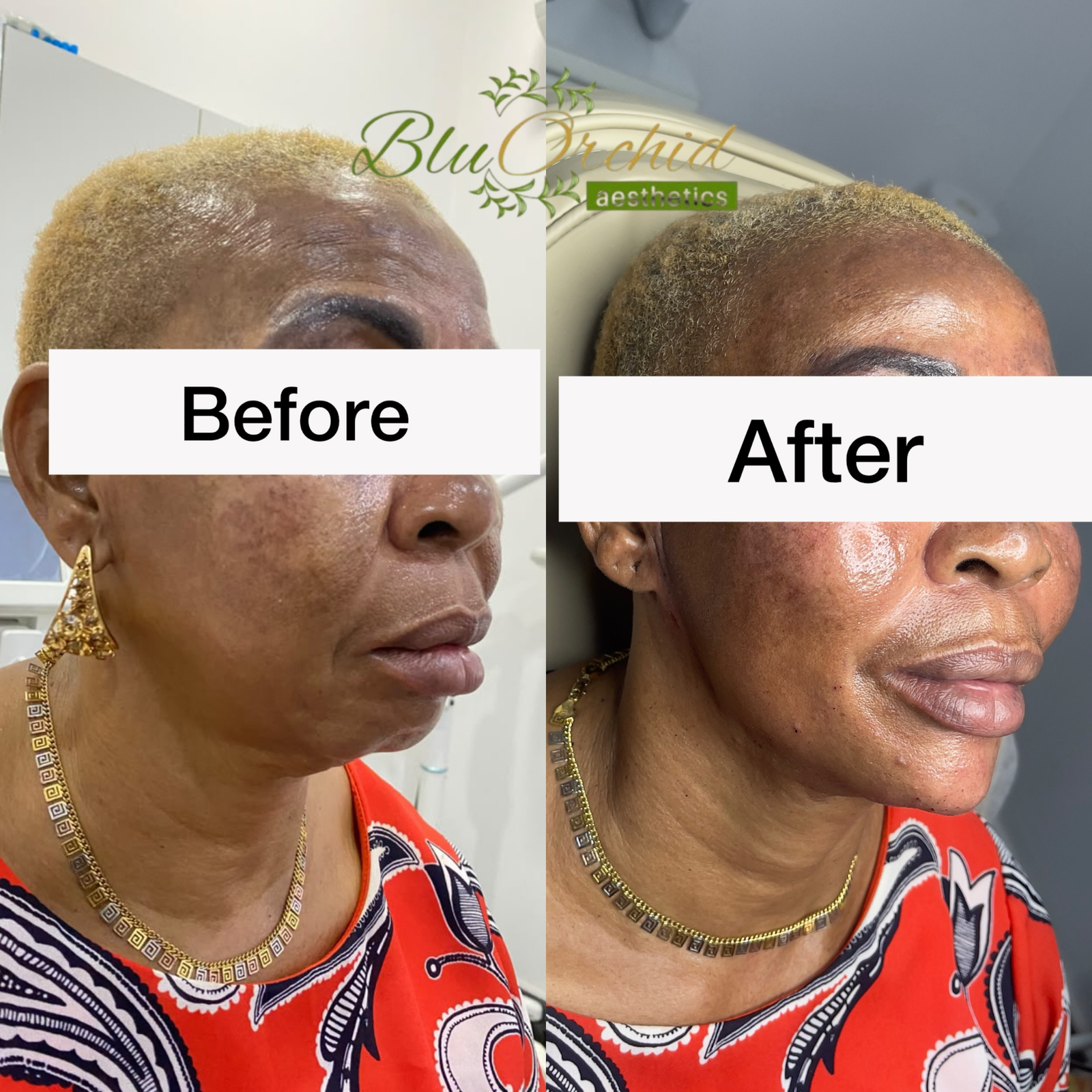
Double chin at BluOrchid Aesthetics, Lagos
What May Take Longer?
Pigmentation can be particularly persistent.
If your skin has experienced repeated inflammation or irritation, the resulting pigmentation may remain long after the original trigger has stopped.
This is one reason people sometimes feel that their skin became “darker” after stopping bleaching.
What they are seeing may be a combination of returning natural pigmentation, existing uneven pigmentation and pigmentation left behind by irritation.
The answer is not necessarily to start bleaching again.
It is to understand what is actually happening.
Can Your Natural Skin Tone Come Back?
This is one of the most common questions.
If you have been artificially lightening your skin, stopping those products can mean that your natural complexion becomes more visible again.
That is not the same as your skin becoming damaged.
Your natural skin tone is not something that needs to be repaired.
The issue is whether the skin is healthy and whether the pigmentation is even.
This distinction is especially important when someone has spent years being told that lighter automatically means better.
It does not.
What If Your Skin Has Become Much Darker After Stopping?
This can be distressing.
You may stop using a lightening product and notice that your skin appears darker, patchier or less even than before.
There are several possible reasons for this, and they cannot be diagnosed from a photograph alone.
Your skin may be returning toward its natural pigmentation.
You may also have post-inflammatory pigmentation from previous irritation.
There may be melasma, acne-related pigmentation or another condition that was previously masked by the products you were using.
This is why simply restarting the old cream is usually not the answer.
If the change is significant or persistent, have your skin assessed.
What If You Used Steroid Creams?
This deserves particular attention.
Topical corticosteroids have legitimate medical uses, but potent steroids should not be treated as ordinary cosmetic lightening creams.
Long-term inappropriate use can contribute to changes in the skin.
If you have been using a potent steroid regularly for cosmetic purposes, do not assume that the solution is simply to replace it with another strong cream.
Bring the product or its packaging to a qualified medical professional.
The strength of the steroid, reason for use and duration all matter when deciding what should happen next.
What If You Suspect Mercury Was Involved?
If you suspect that a product you used contained mercury, do not continue using it simply because it produced visible results.
Keep the original packaging if possible.
Do not assume that a cream is safe because it was popular, recommended by a friend or sold by a well-known vendor.
If you are concerned about exposure, seek professional medical advice.
What Should Your New Skincare Routine Look Like?
After years of aggressive products, the temptation can be to replace them with an equally complicated “repair” routine.
You probably do not need to do that.
The foundation should be simple.
Gentle cleansing
Choose a cleanser your skin tolerates rather than repeatedly stripping the skin in an attempt to feel “squeaky clean.”
Moisturising
A consistent moisturiser can support a simpler, more comfortable routine, particularly when the skin is dry or sensitive.
Sun protection
This is especially important when pigmentation is one of your concerns.
Fewer active ingredients
Introducing several acids, retinoids, brightening products and exfoliants at once makes it difficult to know what your skin can tolerate.
Patience
Your skin did not develop years of problems overnight.
It should not be expected to resolve them overnight either.
When Should You Consider Professional Treatment?
Professional treatment may be appropriate when pigmentation remains after your skin has been stabilised.
This can be particularly useful when:
- Pigmentation is widespread.
- Dark patches keep returning.
- You have persistent melasma.
- Your skin is unusually sensitive.
- You have used potent steroid creams.
- You are unsure what products caused the changes.
- Your skin reacts to most products.
- You have tried multiple routines without improvement.
- You want to understand which treatment is appropriate before spending more money on products.
The important point is assessment before treatment.
Not every pigmentation problem should be treated with the same peel, product or procedure.
Can Professional Treatments Repair Skin Damaged by Bleaching?
Professional treatments can be useful for certain pigmentation and skin-quality concerns, but they are not an eraser for years of inappropriate skincare.
The treatment has to match the problem.
Depending on your skin and diagnosis, a doctor may consider a combination of skincare and professional pigmentation treatments.
At BluOrchid, the objective is not simply to make skin lighter.
It is to understand the condition of the skin and create a treatment approach that supports a healthier, more even complexion.

What You Should Not Do
When trying to repair skin after years of bleaching, avoid the urge to:
Use another bleaching cream to “balance” your skin.
Scrub your skin aggressively.
Layer multiple strong acids together.
Use prescription-strength products because a friend recommended them.
Change products every few days.
Treat every dark patch as the same condition.
Expect a seven-day transformation.
Most importantly, do not punish your skin because you are unhappy with its current appearance.
Recovery requires a different mindset.
The Emotional Side of Repairing Bleached Skin
There is also an emotional part of this conversation that deserves attention.
You may have spent years receiving messages that your natural complexion was not good enough.
You may have been told that lighter skin would make you more attractive, more successful or more desirable.
You may now be looking at the consequences and blaming yourself.
There is no need for shame.
The purpose of treatment is not to judge how you cared for your skin in the past.
It is to help you understand where your skin is now and what can realistically be done.
Your natural skin tone is not damage.
Healthy skin is the goal.
A More Realistic Definition of “Repair”
Repair does not necessarily mean returning your skin to exactly how it looked ten years ago.
It may mean:
- Less sensitivity
- A stronger-feeling skin barrier
- Fewer inflammatory reactions
- More even pigmentation
- Better control of dark marks
- Fewer breakouts
- A simpler skincare routine
- Greater confidence in what you put on your skin
Sometimes the biggest transformation is not becoming lighter.
It is no longer needing to hide behind another product.
Dr Gigi’s Approach: Treat the Skin You Have Now
After years of bleaching, the most useful question is not:
“What cream will make me lighter again?”
It is:
“What does my skin need now?”
That shift changes everything.
Your skin needs to be assessed based on its current condition, not on what it looked like before you started using lightening products.
If pigmentation is present, identify the type.
If inflammation is present, address it.
If the skin barrier is compromised, stabilise it.
If a product has caused a problem, stop repeating the same cycle.
And if professional treatment is appropriate, choose it based on your actual skin rather than the promise of the fastest possible result.
Frequently asked questions
Can skin recover after years of bleaching?
In many cases, the skin can improve significantly after inappropriate lightening products are discontinued and the skin is managed appropriately. The extent and speed of recovery depend on what was used, how long it was used and the current condition of the skin.
How long does it take to repair skin after bleaching?
There is no universal timeline. Some irritation and sensitivity may improve over weeks, while pigmentation can take considerably longer. Persistent or complicated pigmentation may require professional assessment and treatment.
Will my natural skin colour come back after stopping bleaching?
Your natural complexion may become more visible again after stopping products that artificially lighten the skin. This is different from developing skin damage. The important question is whether the resulting pigmentation is even and whether the skin is healthy.
Why did my skin become darker after I stopped bleaching?
Several things may be happening. Your natural pigmentation may be returning, or you may have pigmentation caused by previous irritation, acne, inflammation or another condition. A doctor can help determine the cause rather than assuming that you simply need another lightening product.
Can bleaching damage be completely reversed?
Not every change can be guaranteed to return to exactly how the skin looked before. Some changes can improve substantially, while others may be more persistent. A realistic treatment plan should distinguish between what can improve and what may require longer-term management.
Can I use exfoliating acids to repair bleached skin?
Not automatically. If your skin is already irritated or sensitive, aggressive exfoliation can make the problem worse. The right ingredients and timing depend on the condition of your skin.
Should I use another bleaching cream to even out my skin?
No. If your concern is uneven pigmentation after years of bleaching, continuing the same cycle is unlikely to address the underlying problem. Your skin should be assessed and treated according to the cause of the pigmentation.
What if I used steroid creams for years?
Bring the product or packaging to a medical consultation if possible. The specific steroid, strength, duration and reason for use all matter when deciding how the skin should be managed.
Can a dermatologist or aesthetic doctor help repair bleached skin?
Yes. A medical assessment can help distinguish between irritation, pigmentation, acne, melasma and other concerns and determine whether skincare alone is appropriate or whether professional treatment should be considered.
When should I seek professional help?
Seek professional advice if your skin has become persistently sensitive, unusually thin, patchy, inflamed or heavily pigmented, or if you are unsure what products you have been using.
Your Skin Does Not Need to Become Lighter to Become Better
If you have spent years bleaching your skin, recovery may require patience.
There may be products you need to stop.
There may be habits you need to change.
There may be pigmentation that takes time to improve.
And there may be treatments that can help once your skin is stable enough for them.
But the objective should not be to find a stronger way to change your complexion.
It should be to get your skin to a healthier, more balanced place.
Your natural skin tone is not something that needs repairing. Your skin health is.
If you are unsure where to start, a consultation at BluOrchid Aesthetics can help you understand what your skin needs before you invest in another product or treatment.
Consultations are ₦50,000, with the fee credited towards a selected treatment if you proceed.
A consultation at BluOrchid begins with exactly this assessment.
One hour with our doctors. An honest assessment. A plan built around you. ₦50,000, credited in full toward your first treatment.
Book your consultation Doctor-led assessment at Lekki Phase 1, Lagos.