HIFU on Dark Skin: Is It Safe?
Is HIFU safe for dark skin? Learn how HIFU works, pigmentation risks, what to ask your practitioner and when treatment may not be suitable.

If you have dark skin, you may have been told to be especially careful with aesthetic treatments.
That advice is sensible, but it does not mean every energy-based treatment is unsuitable for deeper skin tones.
HIFU is different from many laser treatments because it uses focused ultrasound energy rather than light absorbed by melanin.
That makes the conversation around HIFU and dark skin different from the conversation around lasers.
But “different” does not mean “risk-free”.
Your skin type, treatment area, device, treatment settings, practitioner experience and medical history still matter.
So, is HIFU safe for dark skin?
It can be appropriate for people with dark skin when it is properly assessed and performed with an appropriate device and treatment plan.
The important question is not simply whether your skin is dark.
It is whether HIFU is appropriate for your particular skin, anatomy and treatment goal.
What is HIFU?
HIFU stands for high-intensity focused ultrasound.
Unlike laser treatments, which use light energy, HIFU delivers focused ultrasound energy into selected tissue depths.
In aesthetic medicine, it may be used as a non-surgical approach to facial tightening and improvement in the appearance of skin laxity.
It may be considered for concerns such as:
- Mild to moderate facial laxity
- Early jowling
- Reduced jawline definition
- Selected areas of neck laxity
- Loss of firmness
The exact effect depends on the device, treatment area, settings and individual patient.
HIFU is therefore not simply a generic “skin tightening machine”.
Different systems and protocols can differ substantially.

Why is HIFU different from laser treatments on dark skin?
This is one of the most important distinctions.
Melanin absorbs light.
That is why some laser and light-based treatments require particular caution in darker skin: the treatment energy can interact with melanin and, depending on the technology and settings, contribute to unwanted pigmentary changes.
HIFU does not work by targeting melanin.
It uses ultrasound energy.
That means the specific pigment-related mechanism associated with some light-based procedures is not the same with HIFU.
However, this should not be simplified into:
“HIFU is completely safe for every dark skin tone.”
No aesthetic procedure should be treated that way.
A person’s skin can still react to treatment, and individual risk depends on more than pigmentation alone.
Can HIFU cause hyperpigmentation on dark skin?
Any procedure that causes inflammation or tissue injury has the potential to produce pigmentary changes in susceptible individuals.
Dark skin is more prone to post-inflammatory hyperpigmentation after certain types of skin injury.
With HIFU, the concern is not that the ultrasound is directly targeting melanin.
The more useful consideration is whether the treatment is appropriately selected and performed without causing unnecessary tissue injury.
This is one reason treatment settings matter.
More energy is not automatically better.
A practitioner should choose treatment parameters according to the device, treatment area, anatomy and clinical objective rather than simply trying to maximise intensity.
Does dark skin need a lower HIFU setting?
There is no universal rule that every person with dark skin should receive a particular lower setting.
HIFU settings are not determined by skin colour alone.
Factors such as:
- The device being used
- The treatment depth
- The treatment area
- Facial anatomy
- Tissue thickness
- The clinical objective
- Previous treatments
- Individual sensitivity
can all influence treatment planning.
This is why it is not useful to judge safety simply by asking whether a clinic uses a “low” or “high” setting.
The better question is whether the practitioner understands the device and can explain why the chosen treatment parameters are appropriate for you.
What are the risks of HIFU?
HIFU is not risk-free.
Depending on the treatment, temporary effects can include:
- Tenderness
- Redness
- Swelling
- Sensitivity
- Temporary discomfort
More significant complications can occur when energy is delivered incorrectly or treatment is poorly planned.
That is why practitioner experience and knowledge of facial anatomy matter.
If you develop unusual or persistent pain, significant swelling, weakness, changes in sensation or other unexpected symptoms after treatment, you should contact the treating practitioner promptly for assessment.
Is HIFU safe for Fitzpatrick V and VI skin?
A Fitzpatrick skin type describes how skin responds to ultraviolet exposure and is commonly used as a broad way of classifying skin phototypes.
People with Fitzpatrick V and VI skin generally have deeper pigmentation.
But skin type alone does not determine whether HIFU is appropriate.
The assessment should also consider:
- Your skin condition
- Your treatment history
- The area being treated
- Your facial anatomy
- The device being used
- The intended treatment depth
- Your history of abnormal pigmentation or sensitivity
The goal is not to treat all dark skin as if it were identical.
What should a practitioner assess before HIFU?
A proper consultation should happen before treatment.
Your practitioner should assess your face and determine whether the problem you want to correct is actually one that HIFU can address.
For example, someone may describe their concern as “sagging” when the dominant issue is actually:
- Volume loss
- Fat distribution
- Skin quality
- Structural changes
- Significant excess skin
HIFU will not solve all of these problems in the same way.
A good assessment should therefore begin with the anatomy and the desired outcome, not with the machine.
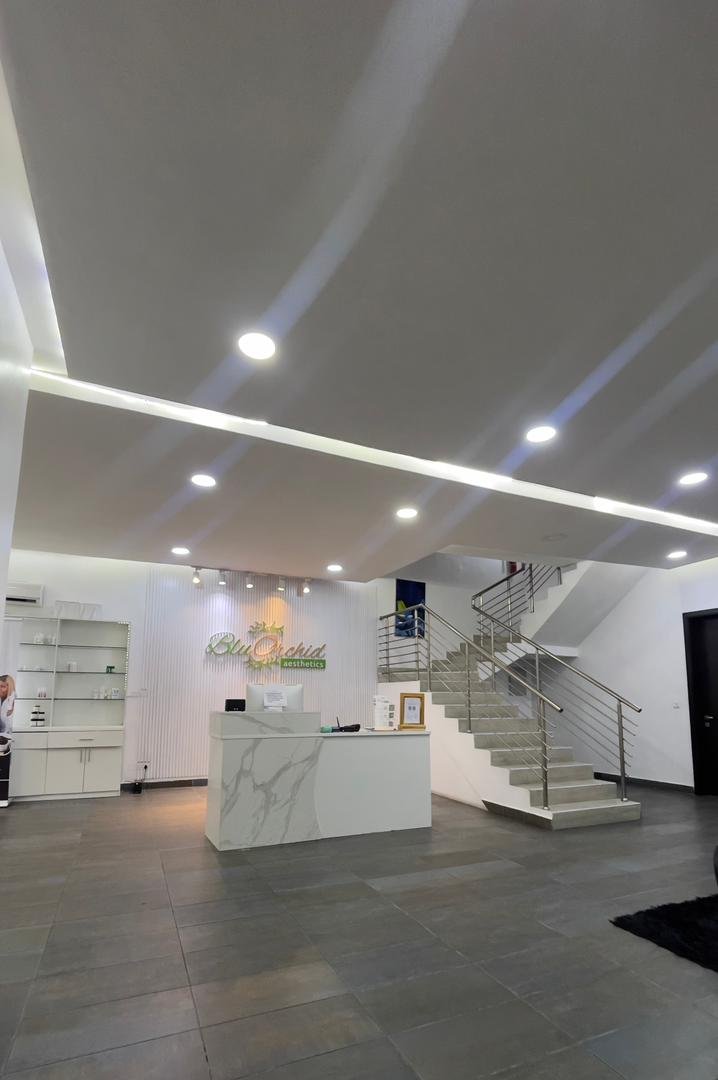
HIFU at BluOrchid Aesthetics, Lagos
Is HIFU suitable for everyone with dark skin?
No.
Having dark skin does not automatically make you unsuitable for HIFU.
But being a candidate for HIFU should be determined individually.
You may need a different treatment approach if you have substantial skin excess, a condition affecting the treatment area, or a concern that HIFU is not designed to address.
The treatment should also be reconsidered if your expectations are unrealistic.
HIFU is not a surgical facelift.
It does not remove excess skin or physically reposition facial tissues in the same way surgery can.
HIFU vs laser for dark skin
It is tempting to compare the two simply by asking which is safer.
That is the wrong question.
They are different technologies used for different purposes.
HIFU
- Uses focused ultrasound
- Can be used for selected tightening applications
- Does not rely on melanin absorption
- Requires appropriate treatment depth and settings
Laser treatments
- Use light energy
- Different lasers target different tissue components
- Some interact significantly with melanin
- Treatment parameters are particularly important in darker skin
The safety profile therefore depends on the specific laser, indication, settings, skin type and practitioner, not simply on the word “laser”.
What about HIFU and melasma or pigmentation?
If your main concern is pigmentation, HIFU should not automatically be considered a pigmentation treatment.
HIFU is generally discussed in the context of tightening and tissue remodelling rather than pigment correction.
If you have melasma, post-inflammatory hyperpigmentation or another pigmentary concern, that should be assessed separately.
Trying to use one treatment to solve every facial concern can lead to disappointment, and sometimes unnecessary treatment.
How can you make HIFU safer for dark skin?
If you are considering HIFU, look beyond the treatment name.
Ask:
1. What device are you using?
You should know what technology is actually being used.
Do not assume that every machine marketed as “HIFU” provides the same treatment.
2. Who is performing the treatment?
Ask about the practitioner’s clinical training and experience with the procedure.
3. Do you regularly treat darker skin?
Experience with skin of colour matters because treatment planning should account for the patient’s individual skin and history.
4. What are you treating?
Ask whether the problem is skin laxity, volume loss, jowling, neck laxity or something else.
5. What should I realistically expect?
A responsible practitioner should explain the likely scope and limitations of treatment rather than promising a facelift-like transformation.
6. What are the possible complications?
You should be given an opportunity to understand the risks before consenting to treatment.
Should you be worried if you have dark skin and want HIFU?
Not necessarily.
Dark skin is not, by itself, a reason to assume HIFU is unsafe.
The bigger concern is receiving treatment without proper assessment or assuming that because HIFU is not a laser, it requires no specialist consideration.
The quality of the treatment decision matters.
That includes the device, practitioner, treatment parameters, treatment area and your individual anatomy.
HIFU on dark skin in Lagos
If you are considering HIFU in Lagos and have dark skin, do not choose a clinic simply because it advertises “non-surgical facelift” or promises dramatic tightening.
Start with an assessment.
Your practitioner should determine whether HIFU is appropriate for your concern and explain what it can realistically change.
At BluOrchid Aesthetics, the starting point is a medical consultation rather than choosing a treatment based solely on an online description.
The objective is to understand your facial structure, skin and goals before recommending an appropriate treatment.
Frequently asked questions
Is HIFU safe for dark skin?
HIFU can be appropriate for people with dark skin when the treatment is properly selected and performed. Dark skin is not automatically a contraindication, but individual assessment remains important.
Does HIFU cause hyperpigmentation?
HIFU does not target melanin in the same way that some light-based treatments do. However, any procedure that causes tissue inflammation or injury can potentially contribute to pigmentary changes in susceptible individuals.
Is HIFU safer than laser for dark skin?
They are different technologies, so a simple “safer” comparison is not appropriate. Some lasers interact with melanin and require particular care in darker skin. HIFU uses ultrasound rather than light.
Can HIFU burn dark skin?
Improper energy delivery can cause tissue injury. This is why appropriate treatment parameters, device knowledge and practitioner experience are important.
Does HIFU lighten dark skin?
HIFU is not a skin-lightening treatment and should not be used with the expectation that it will change your natural skin colour.
Can I have HIFU if I have melasma?
Having melasma does not automatically determine whether HIFU is appropriate. Your practitioner should assess your skin and treatment goal separately. HIFU is not a primary treatment for melasma.
Is HIFU good for dark skin and jowls?
It may be appropriate for selected patients with early jowling or facial laxity. However, jowls can have different causes, so an assessment is important before deciding on treatment.
Is HIFU suitable for Fitzpatrick skin type VI?
Skin type VI does not automatically exclude someone from HIFU. Treatment should still be individualised based on the device, treatment area, anatomy and clinical objective.
Can HIFU replace a facelift?
No. HIFU may improve the appearance of selected degrees of laxity, but it cannot reproduce the tissue repositioning and skin removal possible with facelift surgery.
The bottom line
HIFU is not a laser, and dark skin is not automatically a contraindication to HIFU.
But that does not mean every HIFU treatment is appropriate for every person with dark skin.
The safest approach is to look beyond the marketing claim.
Know the device.
Know who is performing the treatment.
Understand what is actually being treated.
And have your skin, anatomy and expectations assessed before treatment.
For dark skin, the goal should never be simply to find a treatment that is advertised as “safe for all skin types.”
The goal is to find the right treatment, for the right indication, with the right technology and the right practitioner.
A consultation at BluOrchid begins with exactly this assessment.
One hour with our doctors. An honest assessment. A plan built around you. ₦50,000, credited in full toward your first treatment.
Book your consultation Doctor-led assessment at Lekki Phase 1, Lagos.