Hairline Acne From Wigs, Braids and Hair Products
Getting bumps around your hairline after wigs or braids? Learn how hair products, sweat and styling can trigger acne and what can help.

If you keep getting tiny bumps along your forehead after installing a wig, wearing braids or using a new hair product, your hairstyle may not be the only thing to blame.
Sometimes the culprit is what comes with it.
Hair oils.
Edge control.
Pomades.
Gels.
Waxes.
Conditioners.
Styling creams.
Sweat trapped around the hairline.
Residue transferred onto your forehead from your hair, wig cap, scarf or pillowcase.
This type of breakout is common enough to have a medical name: acne cosmetica, acne caused or worsened by products applied to the skin or hair.
The American Academy of Dermatology notes that oily hair-care products can cause tiny bumps and whiteheads along the hairline, forehead and back of the neck.
And for people with darker skin, there is another reason to take these breakouts seriously:
the pimple may disappear, but the dark mark it leaves behind can stay for much longer.
Why does acne appear around the hairline?
The hairline is an easy place for hair products to come into contact with your skin.
You may apply oil or styling product to your hair or scalp, but over time some of that product can spread onto the forehead.
If the product contains ingredients that contribute to clogged pores, you may start seeing:
- Tiny flesh-coloured bumps
- Whiteheads
- Small pimples
- Clusters of bumps along the hairline
- Breakouts around the temples
- Bumps on the forehead
- Similar spots behind the ears or at the back of the neck
The AAD notes that oils in shampoos, conditioners and styling products can contribute to clogged pores and breakouts in these areas.
You may not even realise that the hair product is responsible.
The breakout can look like ordinary acne.

Is it actually the wig or the braids?
Not necessarily.
This distinction is important.
A wig does not automatically cause acne.
Braids do not automatically cause acne.
And there is no medical reason to assume that wearing a protective hairstyle means your skin will break out.
The problem may instead be what is being used with the hairstyle.
For example:
- Hair oil may transfer onto the forehead.
- Edge control may sit directly against the hairline.
- Styling gel may migrate onto the skin.
- A wig cap may trap sweat and product residue.
- Hair extensions may carry product residue close to the face.
- A scarf or bonnet may repeatedly rub against the same area.
- Products may remain on pillowcases and bedding.
So before blaming the hairstyle itself, look at the entire routine.
The Nigerian hair routine can make this particularly easy to miss
Think about what can happen during a typical installation or styling routine.
Your hair may be:
- Washed and conditioned
- Oiled
- Blow-dried
- Braided
- Styled with gel
- Laid with edge control
- Covered with a wig cap
- Covered with a wig
- Wrapped at night
- Re-oiled or restyled between appointments
None of these practices is automatically a problem.
But if you repeatedly apply oily or pore-clogging products around the hairline, the skin may eventually object.
And in Lagos, there is another variable:
heat and sweating.
When sweat, oil, hair products and occlusion all occur around the same area, it can become difficult to work out which factor is actually triggering the bumps.
That is why changing one thing at a time can be more useful than suddenly abandoning your entire hair routine.
What is pomade acne?
You may have heard the term pomade acne.
It refers to acne associated with greasy or oily hair products, particularly when they come into contact with acne-prone skin.
It commonly appears as small bumps or whiteheads around the:
- Hairline
- Forehead
- Temples
- Back of the neck
DermNet describes pomade acne as follicular plugging and comedones along the hairline associated with greasy hair products, and notes that it is seen particularly in people with skin of colour in communities where these hair-styling practices are common.
The solution is not necessarily to stop caring for your hair.
It is to reduce the contact between acne-triggering products and your skin.
What about edge control?
Edge control deserves attention because it is applied precisely where the hair meets the forehead.
If you repeatedly develop tiny bumps along the exact area where your edge product sits, consider whether the product could be contributing.
You do not have to assume that every edge-control product is comedogenic.
Instead, look at the pattern.
If the bumps consistently appear after using a particular product and improve when you stop using it, that is useful information.
The AAD recommends choosing hair-care products labelled oil-free, non-comedogenic or “won’t clog pores” when hair products appear to be contributing to breakouts.
What about hair oils?
Hair oil can be a particularly obvious culprit.
The problem is not that oil is inherently “bad.”
It is that some oily hair products can migrate from the hair onto the skin and contribute to blocked pores.
If your hairline acne is concentrated around the forehead and temples, consider moving oil away from the hairline.
The AAD specifically suggests applying hair oil to the middle of the scalp and ends of the hair rather than directly around the forehead when hair oil appears to be contributing to acne.
That can allow you to continue caring for your hair while reducing unnecessary contact with acne-prone skin.
Can wig caps cause forehead acne?
They can contribute indirectly.
A wig cap sits between your scalp, hair and wig, and depending on the material and how it is worn, it can increase occlusion or trap sweat and product residue around the hairline.
But again, the cap itself is not automatically the cause.
Ask:
- Is the cap clean?
- Does it repeatedly contact the same acne-prone area?
- Are hair oils or styling products underneath it?
- Are you sweating heavily while wearing it?
- Is the wig very tight?
- Does the breakout improve when you stop wearing it?
These clues are often more useful than simply deciding that “wigs cause acne.”
What about braids?
Braids themselves are not automatically an acne trigger.
However, the products used before, during and after installation can be.
Think about:
- Hair grease
- Oils
- Styling gels
- Edge products
- Leave-in conditioners
- Extension products
- Scalp products
If your breakouts appear primarily around the forehead and temples after a fresh installation, examine the products and contact points first.
There is also an important distinction between acne and traction-related hair problems.
Very tight braids can contribute to traction alopecia, a form of hair loss caused by prolonged or repeated tension on the hair. This can affect the hairline and may become permanent if the damaging tension continues.
So a painful or tender hairline after braiding should not simply be dismissed as “normal.”
Acne versus traction: know the difference
These two problems can occur around the same area but are not the same thing.
Acne may look like:
- Whiteheads
- Blackheads
- Small flesh-coloured bumps
- Pimples
- Inflamed spots
Traction-related problems may involve:
- Tenderness after installation
- Pain from tight braids or extensions
- Broken hairs around the edges
- Thinning along the hairline
- A receding-looking hairline
- Loss of density around repeatedly stressed areas
If the main problem is hair loss rather than pimples, treating it as acne will not solve the underlying issue.
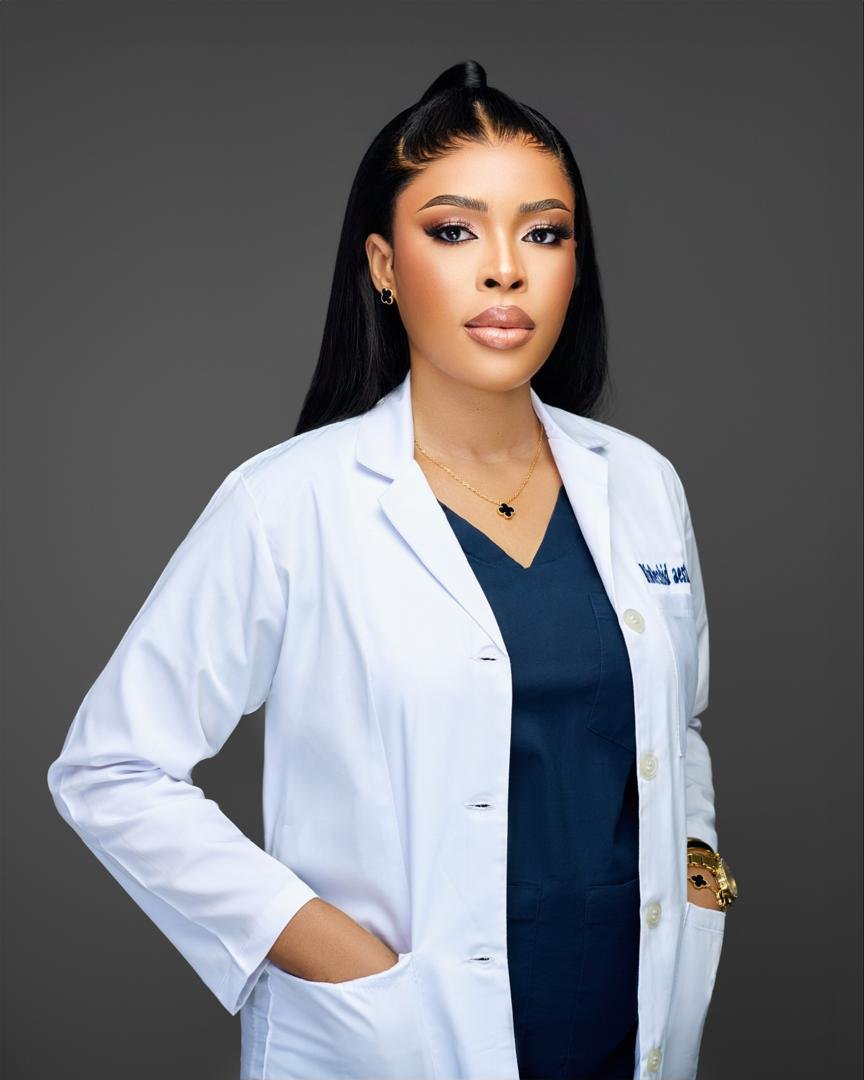
Consultation at BluOrchid Aesthetics, Lagos
What if the bumps are itchy?
This is another reason not to automatically assume every hairline bump is acne.
Some conditions affecting the scalp and hairline can look similar to acne.
Scalp folliculitis, for example, can produce small itchy pustules, particularly around the frontal hairline.
If the bumps are intensely itchy, crusted, painful, rapidly spreading or repeatedly returning despite changing your hair products, you may need a proper clinical assessment rather than simply adding another acne product.
How to stop hair products from causing hairline acne
Start with the simplest changes.
1. Move oily products away from the hairline
If you use hair oil, concentrate it more toward the middle of the scalp and the lengths or ends of the hair rather than directly against the forehead.
This is specifically recommended by the AAD when hair oil appears to be contributing to breakouts.
2. Choose non-comedogenic products where possible
Look for:
- Non-comedogenic
- Oil-free
- Won’t clog pores
- Non-acnegenic
These labels are not a guarantee that a product will suit every individual, but they can help when you are prone to acne.
3. Keep styling products off your forehead
Try to apply edge products precisely to the hair rather than spreading them onto the surrounding skin.
The less product sitting on acne-prone skin, the better.
4. Wash away residue
Hair-product residue can remain on things your head touches.
The AAD recommends washing items such as pillowcases, sheets, caps, hats and headbands that may carry residue.
5. Pay attention to your installation routine
If your acne consistently appears after a particular installation, document what was used.
You may discover that the trigger is not the wig or braid itself but one particular product.
6. Do not scrub the bumps away
Scrubbing aggressively can irritate acne-prone skin and make inflammation worse.
Gentle cleansing is preferable.
How long does hair-product acne take to clear?
Not overnight.
If a hair product is causing the breakout, stopping the culprit can allow the acne to gradually clear.
The AAD notes that it can take around 4 to 6 weeks for this type of acne to clear after stopping the product responsible.
That matters because people often make a mistake here:
They stop one product for four days.
Nothing changes.
They assume it did not work.
Then they start another product.
Then another.
And eventually they have changed ten things at once and have no idea what actually helped.
Give your skin time.
What acne treatment can you use?
If the breakout is mild, reducing the suspected trigger may be enough.
But if acne continues, standard acne treatments may be appropriate depending on the type and severity.
Common acne-treatment ingredients include:
- Salicylic acid
- Benzoyl peroxide
- Adapalene
- Azelaic acid
The appropriate choice depends on the type of acne and your skin. The AAD’s current acne guidance supports several topical therapies, including benzoyl peroxide, topical retinoids, salicylic acid and azelaic acid.
Do not assume that stronger automatically means better.
A very aggressive routine can irritate the skin and make the situation harder to manage.
What if the acne leaves dark marks?
This is particularly important for darker skin.
A small breakout can leave a brown or dark mark called post-inflammatory hyperpigmentation.
DermNet notes that pigmentation after acne can be particularly prominent in skin of colour and may persist after the active acne has gone.
That means the goal is not simply:
“Get rid of the pimples.”
It is also:
“Prevent repeated inflammation that keeps creating new marks.”
This is one reason it is worth addressing a recurring hairline breakout rather than repeatedly covering it up.
Should you stop wearing wigs or braids?
Not necessarily.
If a protective hairstyle is important to you, the goal should be to identify what is actually triggering the acne.
You may be able to continue wearing your preferred style while changing:
- Hair products
- Oils
- Edge-control products
- Wig-cap routine
- Frequency of product application
- Cleansing routine
- How much product reaches the forehead
However, if the style is causing pain, significant tension or hairline thinning, that is a different problem and should be addressed rather than tolerated. Tight braids, weaves and extensions can contribute to traction alopecia.
A simple hairline-acne reset
If you suspect your hair routine is contributing, try simplifying it.
For the next several weeks:
Keep:
- Gentle facial cleansing
- Your necessary hair-care routine
- Non-comedogenic facial products
- Appropriate acne treatment if needed
Reduce or remove:
- Heavy oils near the forehead
- Greasy pomades
- Excessive edge-control application
- Products that repeatedly touch the forehead
- Dirty wig caps, scarves or headbands
Clean:
- Pillowcases
- Wig caps
- Bonnets
- Headbands
- Anything that regularly touches your hairline
Then watch what happens.
The objective is not to strip your skin or hair of every product.
It is to identify whether a particular product or contact pattern is keeping the acne going.
When should you see a doctor?
Consider a clinical assessment if:
- The acne is painful or deep
- You are developing nodules or cysts
- It is leaving scars
- The dark marks are becoming extensive
- The bumps are intensely itchy
- You have persistent pustules around the scalp
- Your hairline is thinning at the same time
- The acne does not improve after removing suspected triggers
- You cannot work out what is causing the recurring breakouts
Deep, painful acne or acne that is already scarring is unlikely to be adequately managed by simply changing hair products. The AAD recommends professional treatment for deeper or scarring acne.
Frequently asked questions
Can wigs cause acne?
A wig itself is not necessarily the cause. Hair products, oils, sweat, residue and occlusion around the hairline may contribute to breakouts. If the pattern consistently appears when wearing a particular wig or wig routine, examine everything touching the skin.
Can braids cause forehead acne?
Braids are not automatically an acne trigger. However, the oils, gels, edge products and other styling products used around the hairline can contribute to acne.
Why do I get tiny bumps around my hairline?
Hair products can cause tiny flesh-coloured bumps and whiteheads around the hairline and forehead. This is commonly referred to as acne cosmetica or, when associated with greasy hair products, pomade acne.
Does edge control cause acne?
It can in some people, particularly when the product repeatedly comes into contact with acne-prone skin. If your bumps appear exactly where you apply edge control, consider stopping or changing the product and observing your skin over several weeks.
Should I stop using hair oil if I have forehead acne?
If you suspect your hair oil is contributing, try moving it away from the hairline and forehead. The AAD recommends applying hair oil more toward the middle of the scalp and ends when hair oil appears to be causing forehead breakouts.
How long does acne from hair products take to clear?
It can take around four to six weeks after stopping the product responsible for the breakout.
Can I still wear wigs if I have acne?
Usually, you do not automatically have to stop wearing wigs. First investigate the products, sweat, residue, cap and contact points involved. If the wig causes significant irritation or your acne consistently worsens with a particular routine, modify the routine or discuss it with a clinician.
Can braids cause hair loss as well as acne?
They can be associated with a separate problem called traction alopecia when the hairstyle places prolonged or repeated tension on the hair. Pain, tenderness and thinning around the edges should not be ignored.
Why do my hairline pimples leave dark marks?
Inflammation from acne can trigger post-inflammatory hyperpigmentation. This can be especially noticeable and persistent in darker skin.
When should I get hairline acne treated professionally?
If the acne is painful, deep, scarring, persistent, intensely itchy or accompanied by hairline thinning, it is worth having the condition properly assessed rather than continuing to experiment with products.
The bottom line
Your wig may not be the problem.
Your braids may not be the problem.
The products and conditions surrounding them may be.
Hair oils, pomades, gels, edge-control products and other styling products can reach the forehead and hairline, where they may contribute to clogged pores and breakouts. Sweat, occlusion and product residue can add to the problem.
The first step is therefore not necessarily to give up your favourite hairstyle.
It is to look at the entire routine.
Simplify the products touching your hairline. Choose non-comedogenic options where possible. Keep wig caps, bonnets, pillowcases and other items clean. Give your skin several weeks to respond.
And if the bumps are painful, persistent, scarring or accompanied by hairline thinning, get the diagnosis right before treating them.
At BluOrchid Aesthetics, persistent acne can be assessed as part of a personalised consultation, with treatment selected according to the type of acne, your skin and the cause of the breakouts.
A consultation at BluOrchid begins with exactly this assessment.
One hour with our doctors. An honest assessment. A plan built around you. ₦50,000, credited in full toward your first treatment.
Book your consultation Doctor-led assessment at Lekki Phase 1, Lagos.