Filler Migration: What It Is and How to Avoid It
What causes filler migration? Learn how dermal filler can move, the signs to watch for and how proper injection technique can reduce the risk.

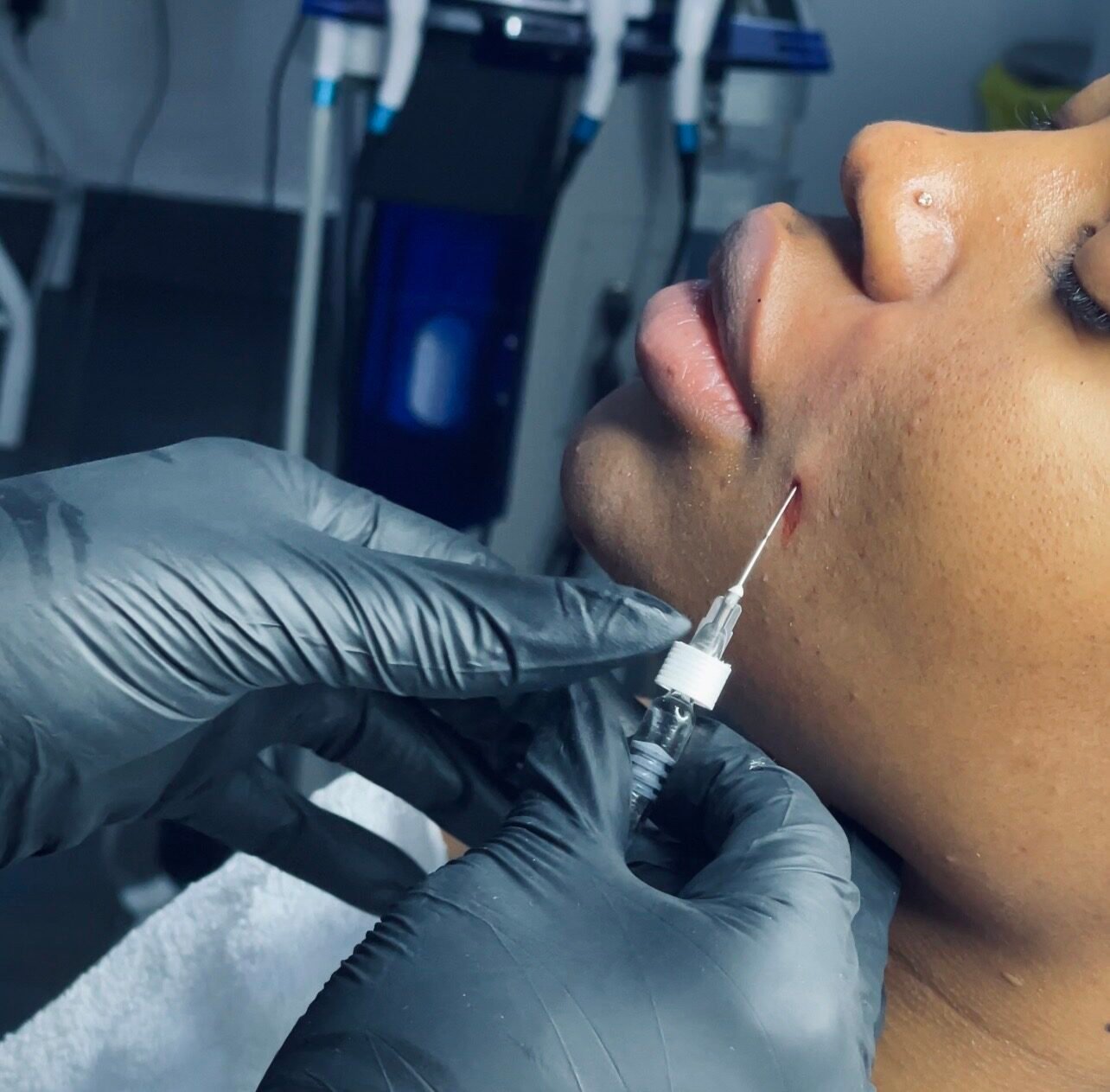
Dermal filler is designed to stay where it is placed.
So when someone notices fullness, swelling, a lump or an unusual contour appearing away from the original treatment area, one question often follows:
Has my filler migrated?
Filler migration is a recognised complication in which filler material is found outside the area where it was originally injected.
It is real, but it is also frequently misunderstood.
Not every lump is migrated filler. Not every swollen area means that filler has moved. And not every change that appears months after treatment can be explained by migration alone.
The appearance needs to be assessed properly before deciding what has happened.
For anyone considering dermal fillers, understanding why migration can occur, and how a qualified injector works to reduce the risk, is more useful than simply trying to find a “no-migration” filler.
What is filler migration?
Filler migration is the movement or displacement of filler material away from its intended injection site.
The U.S. Food and Drug Administration lists migration among the rare risks reported with dermal fillers.
Migration can occur relatively close to the original treatment area or, in some cases, further away.
For example, filler placed around the lips may become visible outside the intended lip area, while filler placed in other facial regions may later be identified in an adjacent area.
The important point is that migration is about the location of the filler material, not simply the appearance of swelling.
A clinician may need to distinguish migration from:
- Normal post-treatment swelling
- Overcorrection
- Asymmetry
- A palpable filler deposit in the intended treatment plane
- Inflammatory nodules
- Granuloma
- Infection
- Tyndall effect
- Scar tissue
- Changes in the surrounding tissues
This distinction matters because the appropriate management depends on the underlying problem.
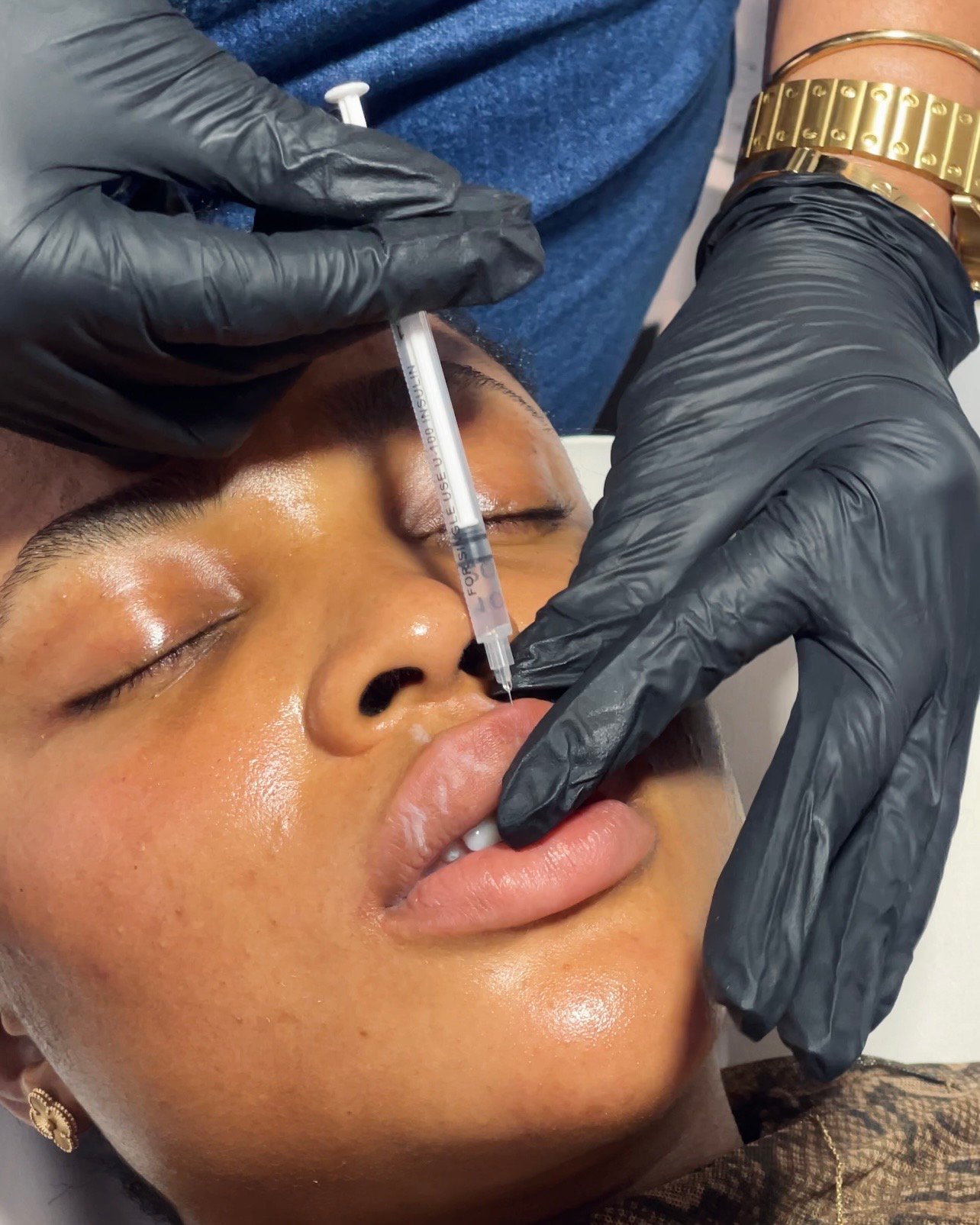
Why does filler migrate?
There is rarely one single explanation.
Filler behaviour can be influenced by the product, the injection technique, the anatomy of the treatment area, the amount injected and the tissue characteristics of the patient.
Research into filler migration has proposed several possible mechanisms, including movement through tissue planes and other pathways from the original injection site. Migration may also become apparent long after the original treatment.
Some of the factors worth considering include the following.
1. Too much filler
More filler is not necessarily better filler.
When a larger volume is placed into an area than the tissue can appropriately accommodate, the result can be excessive fullness, pressure or an unnatural contour.
Overcorrection is not automatically migration, but excessive product can complicate the appearance and assessment of the treated area.
A good injector therefore considers the amount of filler in relation to the patient’s anatomy and the desired result rather than simply aiming for maximum volume.
2. Incorrect placement
Where the filler is placed matters.
Different facial areas contain different tissue layers, structures and planes.
A product that is appropriate for one area may not be appropriate for another, and the injection depth should correspond to the treatment objective and anatomy.
Recent consensus recommendations on filler complications emphasise appropriate product selection and injection depth as part of prevention.
3. Injection technique
Technique matters just as much as product selection.
An injector needs to understand the anatomy of the treatment area and how the product behaves once placed.
The volume delivered, injection pressure, placement, distribution and treatment plan can all influence the final result.
This is one reason why choosing a filler based purely on price or brand name is not enough.
4. Repeated or layered treatments
Filler does not necessarily disappear completely when the patient can no longer see the original result.
Some fillers are gradually absorbed, but residual material may remain.
Repeated treatments can therefore result in additional product being placed over or alongside previous filler.
That history matters.
A 10-point review on preventing filler complications specifically recommends considering previous cosmetic procedures and cautions against indiscriminate layering over older or minimally degradable filler.
If you have had filler elsewhere, tell your injector before receiving another treatment.
5. The anatomy of the area
Some areas are simply more anatomically complex than others.
The face contains multiple tissue layers, muscles, fat compartments, blood vessels and other structures.
An injector who treats the face as a collection of isolated “problem areas” can miss the relationship between one feature and another.
This is particularly important in facial profiling.
The objective is not simply to put filler wherever someone wants more volume.
It is to understand how changing one area affects the balance of the face as a whole.
Does lip filler migrate?
Lip filler is one of the areas where patients commonly talk about migration.
A patient may notice fullness above the upper lip or a change in the border of the lip and immediately assume that filler has migrated.
Sometimes that may be the explanation.
But other possibilities include swelling, product placement, overfilling, the patient’s natural anatomy or an issue with how previous filler has settled.
This is why an assessment is more useful than diagnosing yourself from photographs online.
If you have had multiple lip filler treatments, it is also important to tell your injector when and where the previous treatments were performed.
What does migrated filler look like?
There is no single appearance.
Depending on the location and type of filler involved, a patient might notice:
- Fullness outside the intended treatment area
- An unusual contour
- A visible or palpable lump
- Persistent swelling
- Asymmetry
- A change in the shape of the lips or surrounding tissue
- Firmness or nodularity
However, these signs are not specific to migration.
For example, a nodule can have several possible causes, including inflammatory or foreign-body reactions.
A clinician may therefore need to examine the area rather than assuming that the filler has moved.
In selected cases, imaging such as high-resolution ultrasound can help identify and distinguish different filler-related complications. Recent research has highlighted the value of ultrasound in assessing nonvascular complications of hyaluronic acid fillers, including migration.
How long after filler can migration happen?
Migration does not necessarily appear immediately.
Some cases become noticeable after the initial treatment period, while filler can also persist in tissue for much longer than a patient expects.
A published review of filler migration described cases where filler was identified outside the intended injection site months or even years after treatment.
That does not mean that every late change is migration.
It means that a history of previous filler remains clinically relevant even when the treatment was performed a long time ago.
Can filler migration be prevented?
There is no way to guarantee that migration will never occur.
But several principles can reduce the risk of complications.
Choose a qualified medical injector
The first decision is who performs the treatment.
Dermal filler is a medical procedure, not simply a beauty service.
A qualified injector should understand facial anatomy, product characteristics, injection technique and the recognition and management of complications.
The aim is not merely to achieve a particular look.
It is to achieve it while respecting the anatomy and safety of the patient.
Have a proper assessment before treatment
A consultation should establish:
- What you actually want to change
- Your facial anatomy
- Previous filler treatments
- Previous complications
- Relevant medical history
- Current medications where relevant
- The product and treatment plan being considered
This is particularly important if you have already had filler somewhere else.
Your injector cannot accurately plan a new treatment if they do not know what has already been placed.
Avoid chasing volume
One of the easiest ways to create an unnatural result is to keep adding filler because the previous result no longer feels dramatic enough.
Facial enhancement should not be a competition for volume.
The right amount depends on the individual, the area being treated and the desired outcome.
Sometimes the best aesthetic decision is to add less.
Sometimes it is to wait.
And sometimes the appropriate decision is to dissolve or revise existing filler before adding anything else.
Use an appropriate product for the area
Different fillers have different physical properties.
The choice should take into account the treatment area, tissue characteristics, desired effect and the clinician’s experience with the product.
There is no single filler that is automatically the best choice for every part of the face.
Respect injection planes
Where a filler sits within the tissue matters.
The appropriate depth varies according to the area and treatment objective.
The clinician should understand the anatomy of the region rather than using the same injection approach everywhere.
Be cautious about repeated filler
If you have already had filler, tell your injector.
If you do not know what product was used, when it was injected or how much was placed, say so.
Unknown previous filler can make assessment more difficult.
In some situations, imaging may be useful before deciding on further treatment.
Can massage prevent filler migration?
There is no universal rule that patients should massage their filler to “keep it in place.”
In fact, whether massage is appropriate depends on the specific treatment and the clinician’s instructions.
Do not assume that more manipulation is better.
Follow the aftercare instructions given by your treating clinician rather than applying generic advice from social media.
Can sleeping on your face cause filler migration?
Patients are often told that sleeping position can move filler around.
The reality is more nuanced.
Aftercare instructions may vary depending on the treatment area and the clinician’s technique, but ordinary sleep should not be presented as the primary explanation for filler migration.
If you have been given specific post-treatment instructions, follow them.
If you are concerned that you have developed an unusual contour or swelling after sleeping, contact your clinic rather than trying to correct the area yourself.
Lip filler at BluOrchid Aesthetics, Lagos
Can exercise make filler migrate?
Normal activity is not the same thing as mechanically pushing filler through the face.
Your injector may recommend temporarily modifying strenuous exercise immediately after treatment depending on the procedure and their protocol.
However, persistent filler migration should not simply be blamed on exercise.
If a new lump or contour change develops, it deserves assessment.
What should you do if you think your filler has migrated?
Do not immediately book more filler to “correct” the appearance.
First, have the area assessed.
A clinician may need to determine whether you are actually dealing with:
- Migration
- Swelling
- Overcorrection
- A nodule
- An inflammatory reaction
- Infection
- Another filler-related complication
Treatment depends on the diagnosis.
If the filler is hyaluronic acid, hyaluronidase may sometimes be used to break down the filler. However, hyaluronidase is not an appropriate answer to every lump or swelling and should not be used blindly.
For example, consensus recommendations distinguish non-inflammatory filler-related problems from infection and inflammatory reactions when considering treatment.
That is why assessment comes first.
When should you seek urgent medical attention?
Migration itself is generally discussed as a delayed or nonvascular filler complication.
But someone who has recently received filler should also know the warning signs of a vascular complication, which is a separate and potentially serious emergency.
Seek urgent medical attention if you experience symptoms such as:
- Severe or unusual pain during or shortly after injection
- Skin becoming unusually pale or blanched
- Significant colour change in the treated skin
- New visual disturbance
- Sudden neurological symptoms
The FDA warns that accidental injection of filler into a blood vessel can cause tissue death, vision abnormalities including blindness, or stroke.
Do not wait for these symptoms to “settle.”
Does dissolving filler fix migration?
If migration is confirmed and the material is a dissolvable hyaluronic acid filler, a clinician may consider hyaluronidase.
But this decision depends on what is actually causing the problem.
Hyaluronidase does not simply “reset” the face.
It breaks down hyaluronic acid, including hyaluronic acid that the clinician may wish to preserve.
And if the problem is an infection, inflammatory reaction or another type of complication, the management may be different.
The FDA notes that removal of dermal fillers can require injections, surgery or other interventions, and that some filler materials can be difficult or impossible to remove.
Can migrated filler be removed completely?
Not always.
This depends on:
- The type of filler
- Whether it is hyaluronic acid or another material
- Where it is located
- How much is present
- How long it has been there
- Whether there is inflammation or scarring
- Whether the material can be safely accessed or dissolved
Hyaluronic acid fillers have an important advantage in this context because they can, in appropriate circumstances, be treated with hyaluronidase.
Permanent or difficult-to-degrade materials can be much more challenging to manage.
Filler migration does not always mean bad work
It is understandable to assume that if filler migrates, someone must have made a mistake.
But medicine is rarely that simple.
Technique and product selection matter enormously, but patient anatomy, previous treatments, tissue behaviour and other factors also influence outcomes.
The appropriate response is therefore not to assign blame immediately.
It is to identify what has happened and determine what should be done next.
The safest filler result is not necessarily the biggest one
Good filler work is not about seeing the product.
It is about seeing the face.
The most natural result often comes from understanding proportion, anatomy and the relationship between features rather than repeatedly adding volume to individual areas.
That is particularly important when filler is being used as part of facial profiling.
A chin, cheek, lip or jawline should not be assessed in isolation.
The question is how the feature contributes to the overall balance of the face.
Frequently asked questions
What is filler migration?
Filler migration is when dermal filler material is found outside the area where it was originally injected. It is a recognised but uncommon complication of dermal filler treatment.
Is filler migration common?
It is a recognised complication, but it is not inevitable and should not be assumed whenever swelling or a lump appears. Some filler-related changes that look like migration may have other causes.
Can lip filler migrate above the lip?
It can. However, fullness above the lip can have several possible explanations, including swelling, product placement, overfilling or other filler-related changes. A clinical assessment is needed before calling it migration.
Does filler migration mean the injector did something wrong?
Not necessarily. Injection technique, product choice and anatomy all matter, but other patient and tissue factors can contribute to filler complications.
Can filler migrate years later?
Filler can persist in tissue for longer than patients may expect, and migration has been reported long after the original injection.
Can you prevent filler migration completely?
No treatment can guarantee that migration will never occur. Appropriate product selection, anatomical knowledge, careful technique, conservative treatment planning and proper assessment can reduce the risk.
Does massaging filler cause it to migrate?
Do not assume that massage will prevent or cause migration. Whether massage is appropriate depends on the specific treatment. Follow your injector’s aftercare instructions.
Can hyaluronidase dissolve migrated filler?
If the migrated material is hyaluronic acid, hyaluronidase may be used in appropriate cases. However, not every lump is migrated filler and not every complication should be treated with hyaluronidase.
Is migrated filler dangerous?
Migration itself can create aesthetic and sometimes inflammatory problems. More importantly, patients should understand that dermal fillers also carry separate serious risks, including vascular occlusion, tissue necrosis, vision loss and stroke.
Should I get more filler if I think my filler has migrated?
Usually, the first step should be assessment rather than adding more filler. Adding product without understanding the existing problem can make diagnosis and correction more difficult.
The best way to avoid filler migration
You cannot control every variable.
But you can control some of the most important ones.
Choose a qualified injector.
Tell them about previous filler.
Have your anatomy assessed rather than requesting a treatment solely because you saw it online.
Ask what product is being used and why.
Avoid chasing volume.
And if something does not look or feel right after treatment, have it assessed rather than trying to correct it yourself.
At BluOrchid Aesthetics, dermal filler is approached as part of the architecture of the face, not simply as a way to add volume to an individual feature.
If you are considering filler or are concerned about a previous treatment, Book a Consultation to have your facial anatomy and treatment history assessed before deciding on your next step.
The consultation fee is ₦50,000 and is credited towards your selected treatment if you decide to proceed.
A consultation at BluOrchid begins with exactly this assessment.
One hour with our doctors. An honest assessment. A plan built around you. ₦50,000, credited in full toward your first treatment.
Book your consultation Doctor-led assessment at Lekki Phase 1, Lagos.