Chin Filler Before and After: Profile Balancing
Chin filler before and after: learn how chin and jawline filler can change facial proportions, profile balance and definition without surgery.

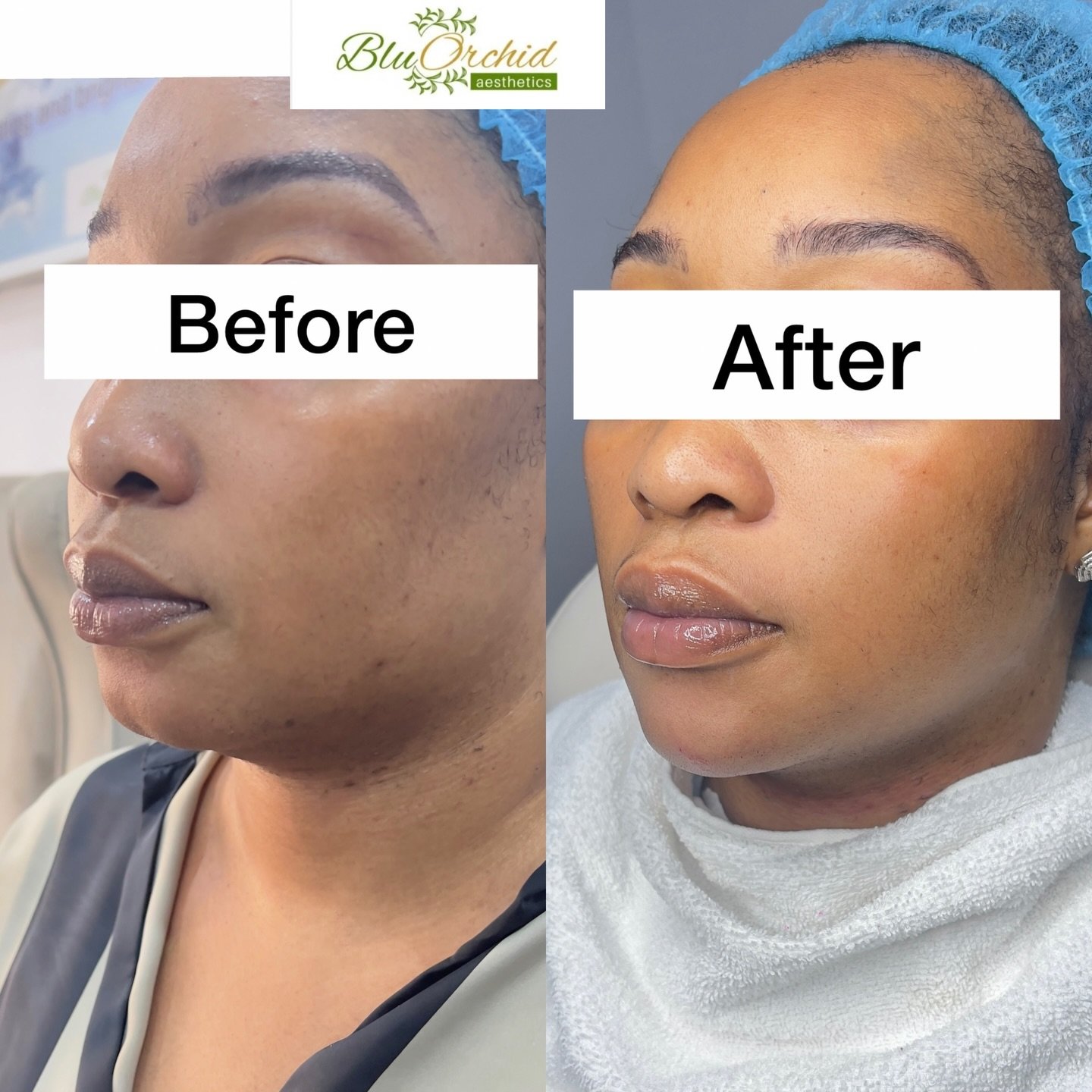
When people consider chin or jawline filler, they often start with a very specific request: “I want a sharper jawline” or “I want my chin to project more.”
But the most natural-looking results are rarely about adding as much definition or projection as possible.
They are about proportion.
The chin sits at the centre of the lower third of the face and has a significant influence on how the lips, nose, jawline and neck appear in relation to one another. A subtle change in chin projection can therefore change the way the entire profile is perceived.
This is why two people can receive the same amount of filler and have completely different-looking results.
For one person, adding projection may make the profile feel more balanced. For another, the same approach could make the chin appear too prominent.
This is where profile balancing becomes important.
What does chin filler actually change?
Chin filler uses an injectable dermal filler to add volume and projection to the chin.
Depending on the person’s anatomy and the treatment plan, this may be used to influence the:
- Projection of the chin from the side
- Length or visual height of the lower face
- Shape and definition of the chin
- Relationship between the chin and lower lip
- Appearance of the jawline
- Transition between the chin, jawline and neck
The goal is not necessarily to create a dramatically different chin.
In many cases, it is to make the existing structure sit more harmoniously within the face.
Research on injectable chin augmentation supports the role of filler in improving chin projection and lower-face balance, although the evidence varies between techniques and products and does not establish one universal aesthetic formula.

Why your chin can change the appearance of your whole profile
Look at a face from the front and you may focus on the eyes, cheeks, lips or skin.
Look at the same face from the side and the relationship between the nose, lips and chin becomes much more apparent.
A chin that sits further back can make the nose appear more prominent. A chin that lacks definition can make the lower face appear softer. In some people, improving chin projection can create the impression of a more balanced profile without changing the nose at all.
This is why facial assessment should not treat the chin as an isolated feature.
The chin is part of a larger three-dimensional structure.
A proper assessment considers the face from the front, side and oblique angles rather than making a decision from one photograph alone. Lower-face assessment literature similarly emphasises the importance of evaluating both anterior and profile views.
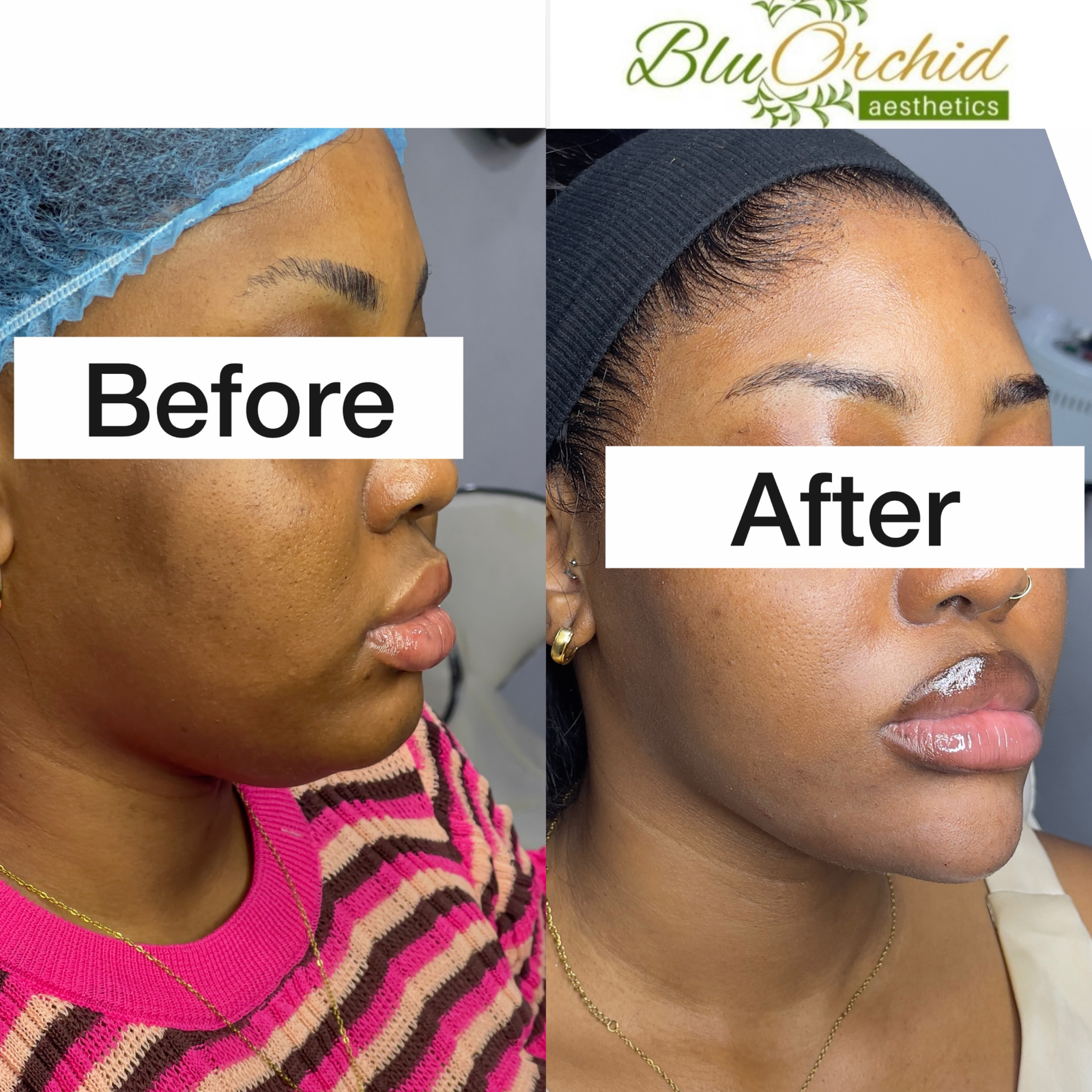
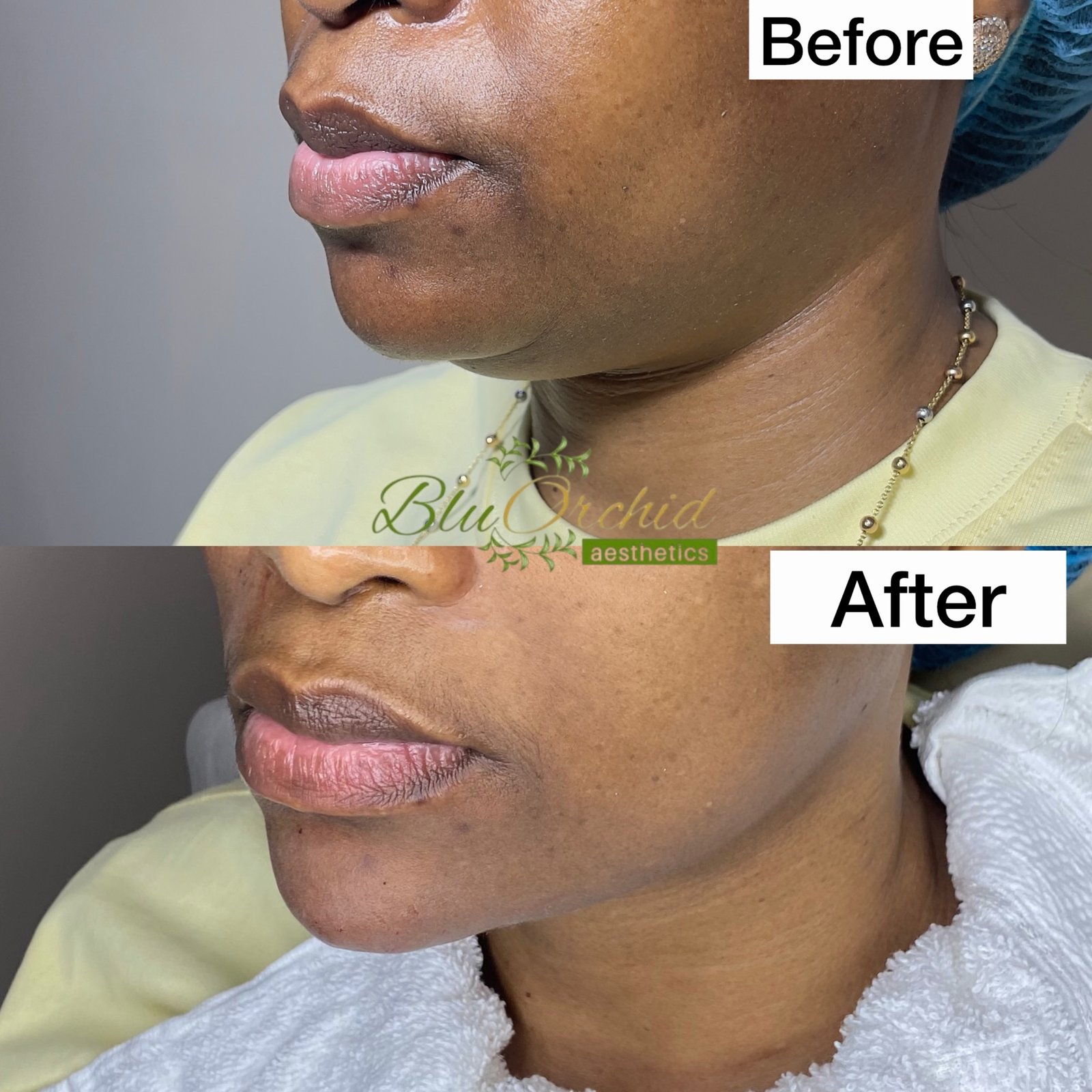
Chin filler before and after: what should you actually look for?
If you are searching for chin filler before and after photographs, it is tempting to look for the most dramatic transformation.
That can be misleading.
A better question is:
What changed in the relationship between the features?
Look at the profile.
Has the chin become more appropriately projected relative to the nose and lips?
Look at the lower third.
Does the face appear more balanced, or simply longer?
Look at the jawline.
Has additional definition created a cleaner transition from the chin towards the jaw, or has too much volume made the lower face look heavy?
And finally, look at the front view.
Does the chin remain proportionate to the width and structure of the rest of the face?
A successful result should make sense from more than one angle.
Profile balancing is not the same as following a formula
You may have heard of the Golden Ratio in facial aesthetics.
It is often presented online as though there is one mathematical formula that can determine exactly what a beautiful face should look like.
Real faces are more complicated.
Facial proportions can be assessed using measurements and established aesthetic relationships, but beauty is not determined by one number. Different populations, facial structures, ages and individual characteristics produce different proportions.
Research into chin aesthetics, for example, has identified meaningful relationships between the chin and other facial structures, while also emphasising the importance of individual anatomical assessment.
The Golden Ratio can therefore be useful as part of a broader conversation about proportion.
It should not become a prescription for making every face conform to the same template.
At BluOrchid, the more useful question is not:
“How close can we get you to an ideal ratio?”
It is:
“What does your face need to look balanced?”
Facial profiling at BluOrchid Aesthetics, Lagos
What can chin filler do for a recessed chin?
A relatively recessed chin can affect the appearance of the side profile.
In appropriate patients, filler can add controlled projection to bring the chin forward visually.
That does not mean filler can change the underlying bone.
It is a soft-tissue treatment, so its effect is created by adding volume rather than surgically repositioning the jaw.
Clinical studies have found that hyaluronic acid filler can improve the appearance of mild to moderate chin retrusion, with effects persisting for months in some patients. However, individual results vary and filler is not equivalent to a surgical chin procedure.
This distinction matters.
If the underlying issue is substantial skeletal retrusion, significant bite or jaw abnormalities, or another structural concern, filler may not be the appropriate solution.
What can jawline filler change?
Jawline filler is generally used to add definition or contour to selected areas along the lower face.
The intention might be to create a more defined transition between the chin and jaw, improve the appearance of a softer jawline, or restore some structure that has become less defined with age or changes in facial volume.
But “more jawline” is not automatically better.
A jawline that looks attractive on one face may look heavy or disproportionate on another.
The treatment therefore has to consider:
- Chin projection
- Jaw width
- Facial width
- Lower-face height
- Soft-tissue volume
- Existing jawline definition
- The relationship between the jaw, chin and neck
Recent clinical work on non-surgical lower-face contouring similarly describes treatment planning around facial proportions and anatomical landmarks rather than using an identical injection pattern for every patient.
Chin filler and jawline filler are not always needed together
Another misconception is that anyone having chin filler should automatically have the jawline treated as well.
Not necessarily.
Some patients may benefit primarily from chin projection.
Others may need more definition along selected parts of the jawline.
Some may not need filler at all.
And sometimes the concern that appears to be a “weak jawline” is actually related to the chin, surrounding soft tissue, facial structure or another feature entirely.
This is one reason a consultation should come before deciding how much filler you need.
The treatment plan should follow the anatomy, rather than the other way around.
Why adding more filler can sometimes make the result less natural
There is a point at which additional volume stops improving balance.
For example, excessive forward projection can make the chin look disproportionately prominent. Excessive width can make the lower face appear heavier. Adding volume in multiple areas without considering the overall structure can create a result that looks treated rather than harmonious.
Natural-looking enhancement often comes from restraint.
The aim is not to make the chin or jawline the first thing someone notices.
It is to improve how the features relate to one another.
That distinction is particularly important for patients who want people to notice that they look refreshed or more defined without immediately identifying what has changed.
What happens during a chin or jawline filler consultation?
A proper consultation should begin before any decision about syringe volume or injection points.
Your clinician may assess your face from multiple angles and consider:
- Your profile
How does the chin relate to the nose, lips and forehead?
- Your lower facial proportions
Is the lower third proportionate to the rest of the face?
- Your chin shape
Is the concern projection, width, height, asymmetry or definition?
- Your jawline
Where is definition actually lacking?
- Your expectations
Are you looking for subtle refinement or a more noticeable structural change?
- Whether filler is appropriate
Not every concern is best addressed with an injectable.
The consultation is therefore not simply about deciding where to put filler.
It is about determining whether filler is the right tool for the result you want.
Does chin filler make the face look longer?
It can.
Adding vertical height or projection to the chin may change the visual proportions of the lower third.
But whether that is desirable depends on the individual’s starting anatomy.
Someone with a short-looking lower third may benefit from carefully planned chin enhancement. Someone who already has a long lower face may not.
This is another reason why a treatment plan cannot be based solely on a reference photograph.
Your anatomy comes first.
Can chin filler make the jawline look sharper?
Sometimes.
Improving chin projection can make the transition through the lower face appear more defined, even without extensively treating the jawline.
Direct jawline filler can also be used in selected patients to create additional contour.
But the perceived sharpness of the jawline depends on more than filler. Bone structure, soft-tissue volume, skin quality, muscle, facial proportions and the relationship between the chin and neck all contribute to how the lower face appears.
Filler can modify some of these visual relationships.
It cannot reproduce every structural change that surgery or other treatments may provide.
Is chin filler permanent?
Most commonly used facial fillers are temporary and are gradually broken down by the body.
How long the visible effect lasts depends on the filler material, the treatment area, the amount used and individual factors. The FDA notes that some fillers are absorbed over time and may need to be repeated to maintain the desired effect.
This is one of the advantages of using a temporary injectable for patients who want to assess a change before considering a more permanent intervention.
It is also important to understand that temporary does not mean risk-free.
What are the risks of chin and jawline filler?
Like any injectable treatment, dermal filler has potential side effects and complications.
Common short-term effects can include:
- Swelling
- Bruising
- Redness
- Tenderness
- Itching
- Temporary lumps or irregularities
More serious complications are uncommon but can occur.
One of the most important concerns with dermal filler is inadvertent injection into a blood vessel, which can cause vascular occlusion and tissue injury. Very rare but serious complications can include skin necrosis, visual impairment or stroke.
This is why the expertise of the injector and understanding of facial anatomy matter.
The chin and jawline are not simply empty spaces where filler can be placed wherever additional volume is desired. They contain important anatomical structures, including blood vessels, nerves and muscles, and risk varies by facial region.
Chin filler versus a surgical chin augmentation
Filler is not a replacement for every form of chin surgery.
A surgical procedure can make more substantial and durable structural changes to the chin and jaw.
Filler, by contrast, is minimally invasive and can provide temporary changes in projection and contour.
The right choice depends on the degree of structural change required, your anatomy, your expectations and your willingness to undergo surgery.
There is no single option that is automatically better for everyone.
The real goal is facial balance
The most important thing to understand about chin and jawline filler is that the treatment should not be planned around the chin alone.
Your face is a system of relationships.
Move one feature forward and another may appear less prominent.
Add definition to one area and another may appear softer by comparison.
Change the chin and the relationship between the nose, lips and lower face can look different.
That is why profile balancing is so important.
A skilled aesthetic assessment does not ask, “How much filler can we put here?”
It asks:
“What change would make this face feel more balanced while still looking like the person?”
That is a very different approach to aesthetic enhancement.
Frequently asked questions
Does chin filler change your profile?
Yes. By adding volume and projection to the chin, filler can alter the appearance of the side profile and the relationship between the chin, lips and nose.
How much filler do I need for my chin?
There is no universal amount that is appropriate for everyone. The amount depends on your anatomy, the desired change, the filler selected and the clinician’s assessment.
Does chin filler make your jawline sharper?
It can improve the appearance of lower-face definition in selected patients. However, chin projection and jawline definition are separate considerations, and not everyone needs both treated.
Can chin filler fix a weak chin?
It can improve the appearance of a mildly recessed chin by adding projection. It cannot reposition the underlying jawbone, so more significant structural concerns may require a different approach.
Will chin filler make my face look longer?
It can alter the visual height or projection of the lower third. Whether this is beneficial depends on your existing facial proportions.
Is chin filler the same as jawline filler?
No. Chin filler focuses primarily on the chin, while jawline filler is used to add definition or contour along selected areas of the jaw. They may be used together, but they do not have to be.
Is chin filler safe?
Dermal filler has a well-established clinical use, but it is not risk-free. Common reactions include swelling and bruising, while rare serious complications can occur if filler enters a blood vessel. Proper patient assessment, anatomical knowledge and appropriate clinical technique are important.
Should I get chin filler before or after other facial treatments?
That depends on your overall facial plan. Because the chin influences facial proportions, it can be useful to assess the entire face before deciding which feature should be treated first.
Thinking about chin or jawline filler?
If your concern is your profile, lower-face proportions or jawline definition, the first step should not be choosing a syringe size.
It should be understanding what is actually creating the imbalance.
At BluOrchid Aesthetics, facial enhancement is approached through individual assessment rather than a one-size-fits-all treatment plan.
If you are considering chin or jawline enhancement, you can Book a Consultation to discuss your facial structure, goals and appropriate treatment options.
The consultation fee is ₦50,000 and is credited towards your selected treatment if you decide to proceed.
A consultation at BluOrchid begins with exactly this assessment.
One hour with our doctors. An honest assessment. A plan built around you. ₦50,000, credited in full toward your first treatment.
Book your consultation Doctor-led assessment at Lekki Phase 1, Lagos.